

Aren’t we done with researching Ed Fay already?
Well, no, we are not *done* with Edgar Fay. In genealogy, I am not sure we ever complete our research on a person, since I doubt it is possible to learn everything about any individual. Usually we cease to pursue when we are out of easy research sources; harder research sources are more difficult to access; the likelihood of finding information is significantly less than the effort required; or, another, competing research interest or genealogical subject captures our attention and energy. We only have a so much time on earth to do this research, so we are wise to strategize to make the most of our efforts.
With Edgar currently, specific, pertinent research sources are more difficult to pinpoint and access, largely because the obvious online, digitized options have been investigated, and beyond that, we do not know geographically exactly where we should look. Consequently, with each potential option we approach, we must consider a cost/benefit analysis of effort vs. likelihood of helpful research findings.
Here are some remaining major research questions regarding the life of Edgar Fay. Most focus upon the missing time period of 1893-1917, as well as his disappearance after 1930, which we have not fully tackled in our blog, pending more research. From this point forward, research will be with an eye toward clues for each of the time periods simultaneously, realizing that work and connections Edgar had earlier in his adult life could also have influenced his choices and strategies in finding work in the 1930’s.
- What evidence can definitively tie the Edgar Fays in our Finding the Mysterious Edgar Fay, Part 3 to the Edgar Fay who grew up in Morrison M. and Cynthia Fay’s home, left home in spring 1893, then married Mellie Burns in Clark County, Arkansas in 1917? We found several pieces of evidence for Ed Fay mining and working in livery stables in Colorado, then living in Lincoln County, Oklahoma in 1910 (U. S. Federal Census). Which of these, if any, are “our” guy? It is great circumstantial evidence, that can tie Ed to Mellie, whose maternal grandmother and great-grandmother were living in Oklahoma City 1900 until their deaths, but can we find more definitive facts to connect the couple?
- Is there evidence of Ed’s employment?
- Is there any evidence of an earlier marriage or other family connection for Ed?
- Is there any evidence of other names/dates of birth Ed may have used?
- What became of Edgar Fay when he left to find work after 1930 and did not return home? Is there evidence of any employment in the 1930’s that would substantiate our theory of his continuing to find gig work in the entertainment and/or horse riding or horse-tending/training businesses?
Source of Potential Importance
Part 3 of our Edgar Fay series was written during the beginning of the pandemic, right after a deep dive into the Tompkins papers at the Oklahoma History Research Center in Oklahoma City, Oklahoma, which highlighted a couple with connections to Wild Bill Cody’s show and their personal wild west enterprises in Oklahoma. Even as I left the center, I was captivated by my becoming aware of a trove of papers of Gordon William “Pawnee Bill” Lillie, a friend of the Tompkins, at the Western History Collection on the campus of the University of Oklahoma in Norman. I had called the site of the collection to verify availability, hours, and process for research when everyone’s course dramatically shifted, with no travel, no research anywhere, a condition that persisted for quite some time. Some would say things are not entirely back to normal, or at least procedures have shifted permanently, in some ways, for the better.
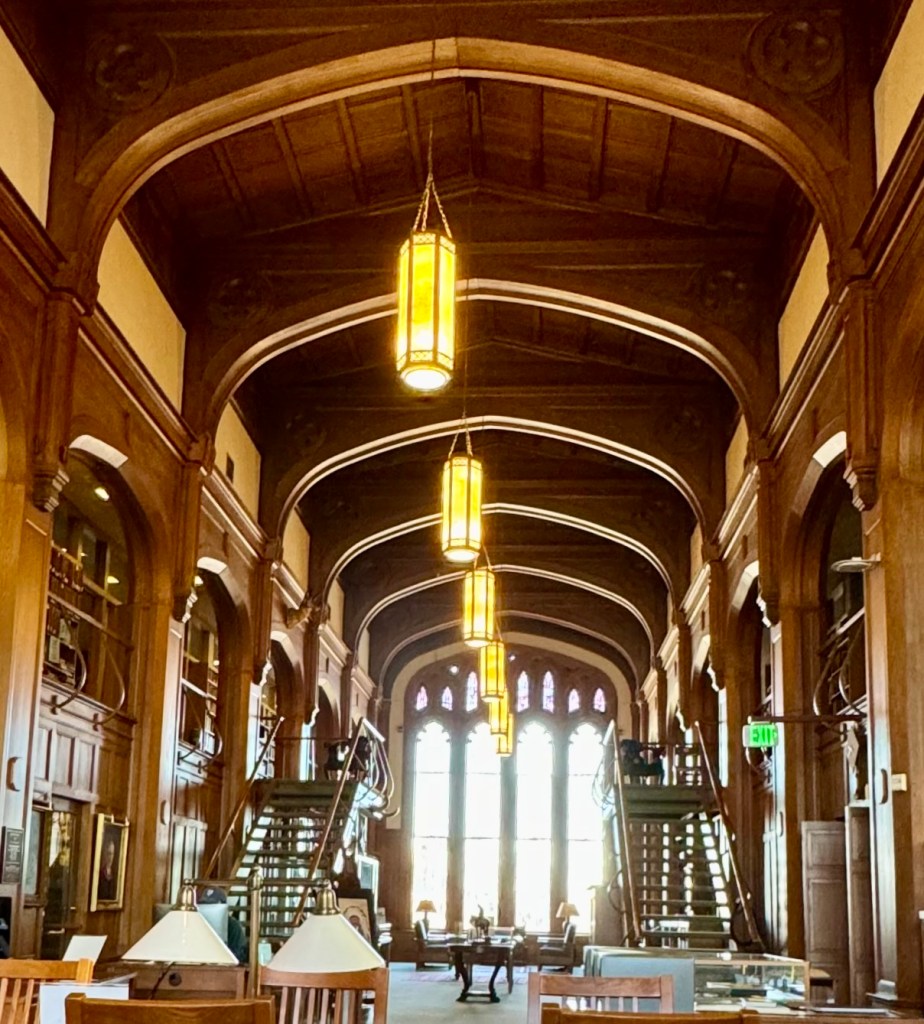
I am happy to report that last month I completed my 2nd day of research, across two weeks, at the Monnet Law building, the former home of the OU law school, which officially houses the Lillie Collection. I also plan to return to look at other sets of papers that may yield clues.
This writing is my chance to document my recent findings and my process, both worth reflecting upon. Not all of the practices I will describe are exclusive to my research, nor are they the only tips you may be given by others, but they are “pro tips” reflective of my experiences. The following practices apply not only to libraries and archives, but also to locations where court/legal/land documents are maintained. Assume that each research location has a policy and practice unique to that institution, even within the same state, and even within the same county.
How to Approach
- Remember that not all facilities are set up for researchers or genealogists; they may be functioning court houses where staff are not particularly oriented to the needs or requests of a researcher.
- The distance you will have to travel to an archive makes some difference in how you approach your mission.
- Are you familiar with the area geographically?
- Will you need to research for several straight days, if you are traveling a long distance?
- How large is the archive, and is there a feel for how long it will take to accomplish your research? Know that going through a box of cancelled checks may take much longer than a box of show programs, not only with respect to quantity and size of items, but challenges in deciphering the writing.
- Check the website.
- Familiarize yourself as much as you can about the collection. Is there a list of what is contained?
- Is there a process listed for contacting the archivist about the collection and requesting a visit?
- Contact the researcher/librarian.
- Do not assume that all the instructions and availability of items are accurately depicted on the website.
- Do your best to make your contact with the archivist as directed on the website. Sometimes there is a form to submit as a query; sometimes there is a live chat available.
- Verify availability of the files/collection you want to see; hours and days of the week they are open for research; and if they will be open on the day(s) you plan to travel. Additionally, a facility may allow only a limited number of researchers at a time, and you have the option to make a reservation.
- In my experience with the G. W. Lillie Collection, the entire collection was out of circulation for maintenance, and therefore unavailable for several weeks/months.
- The archivist offered to take my contact information and inform me when it was available. There are still a couple of boxes not available that I may want to see later.
- Verify the process by which you will request the specific files/boxes to be reviewed.
- The archivist may send you, by return email, or send you to a web-link describing the process for requesting, usually just so many boxes at a time, and how/when to request more. Often, the files are stored off-site and must be transported.
- You may be required to reserve a time slot for research, and these may fill quickly, so do not delay to check on your options, particularly if you only have specific dates available to research.
- Be aware that each location has stipulations for accessing, including use of cell phones or not; pens vs. pencils (almost always pencils); availability of copy services; how to pay for copy services, possible options including cash, credit card, or refillable smart card. Be prepared to have loose, blank pages of paper and pencils with erasers; a folder to hold the paper may be allowed.
- Ask about requirements to access the records, including registration as a researcher or procurement of a library card. Some facilities only allow in-state residents to access the facility’s records. Others may allow guests who must apply for a card in-person.
- Be aware of limitations of posting photos of items within a collection on your blog or website. They often are protected with some sort of copyright or protected arrangement, sometimes by the donor of the papers. The archivist can give you guidance regarding requirements for the collection in question.
- At all times, of course, treat staff with the utmost courtesy.
- Some are permanent staff; others are volunteers or students. Any will be as helpful to you as they can, within what they can and are allowed to do, given time constraints and any regulations in place.
- Sometimes volunteer staff do not understand the backstory or reasons for the policies, so are at a loss to explain them. Just know that fragility of records, privacy concerns, and donor stipulations cover most of the rational.
- Check other resources for important information about how to carefully handle documents, keeping them in order and handling minimally. Use the same care that you would give to archival photos.
- Target the boxes/files most likely to have the information you will find beneficial to your project.
- Get recommendations from the archivist for parking options near the facility and any extra instructions for arrival.

Personal Considerations
- Do your best to care for yourself. When you drive a long way, it makes sense to work for an extended period of time. Especially if you think you can accomplish all the research in a day, you may consider more of a marathon approach, if you can handle it.
- Arrive early to find your parking and locate break/coffee/lunch options.
- Even the second day that you travel to the facility, when you think you know where you are going, your GPS may take you somewhere you did not intend, requiring you to re-calibrate and arrive a bit later than you intended. Yes, it happens.
- Arriving early the first day lets you locate where you are going and plot the surrounding area for rest rooms; water replenishment sites; eateries and menu offerings for coffee or lunch.
- A college campus may yield a library or union; older buildings and court houses are less likely to have many services; there may be public restaurants within walking distance.
- Bring a reusable, sealed water bottle that you can stow while you are researching, but have handy for break time. You can always step out of the area into the hallway, or outside, to refresh yourself, and many facilities do have places to refill your water bottle. Having a packaged protein or power bar handy is a good idea, in case you are thick into your research and do not want to take a long break to fetch food.
- Take breaks and walk around as you need.
- Prepare for the likelihood that you may not be allowed to have at ton of gear at the research table, but rather will need to stow in a cubby that may be unsecured. Keep minimal credit cards and your ID on your person, and avoid bringing anything else that can be stolen.
- Dress business casual… be comfortable, but look somewhat professional. Cargo pants are pretty handy, this researcher has found.
- Consider having a scanning app on your smartphone, such as SmartScan Pro. After you scan items, you can upload to files on your preferred cloud account and rename the files so you can identify them. The quality of the scans via the app is excellent, as long as you check to be sure your settings are good and make sure you check the most important items, as you scan them, to be sure you are satisfied with the images
- If you are using your phone a lot for scanning, bring an external battery pack to recharge as needed.
- You might have a large, black handkerchief and a portable light in your car trunk in case the lighting in your facility is very poor. The handkerchief is to lie flat with the document to be scanned on top, providing contrast for the edges of the paper as you scan. The light can be placed to minimize shadow. Of course, be sure these items are allowed by the facility.
- I have been in some court houses that did not allow ANY cell phones in any part of the court house, at all… even in archival storage areas. I have had to run back out to the car to lock my phone in my trunk. The rule was due to a judge’s opposition to smart phone use in the courtroom, I was told, despite the fact that the ruling applied well beyond the courtroom.
- Make notes of what boxes you have researched, and if you find something, in what file in what box can it be found? You may need to return to it sometime, and/or you may need to use the specific location of the item as documentation citation.
- Of interest– the archivists on staff may not have expertise in the particular area you are researching, but only regarding knowledge about the collections in the facility. If you are fortunate to be able to converse with the archivist(s) and explain your areas of interest, you may learn of other materials in their facility that may be helpful to you. Still, sometimes, you may need to ask directly about specified collections, “Do you know where the ____ papers are held? Oh, really? You have those too?!”
Why Pawnee Bill?
As a reminder, a Fay family history/story was that Ed Fay worked for some sort of circus or rodeo, prior to his 2017 marriage. As we put together the timeline for his disappearance, it became clear that in 1893, the year that Ed, aka Wooster A. Fay, left home, the Chicago Exhibition was in preparation, and Buffalo Bill Cody, whose ranch was not far from the location of Wooster’s home and school, was reformulating his entire wild west show, which ultimately performed in an area adjacent to the Exhibition for most of the duration of it. In that era, circus/rodeo/wild west show were synonymous terms, with overlapping acts. Many of the individuals who performed with Buffalo Bill went on to have their own shows or ranches, and to work with other shows, all of which were seasonal work. Many of these individuals had serious ties to Oklahoma, either wintering in or establishing ranches and permanent shows in Oklahoma. Oklahoma City and areas to the northeast, so far, are the preferred locations I have found. All of these are near Lincoln County, Oklahoma, where a “single” Ed Fay, age 30, was working as a farm hand for a family in the 1910 census. Location of his birth as Iowa and identification of the birth states of his parents as New York and Iowa seem to point to our Ed, although his father’s birth place should be Ohio. Since the father’s family had moved to Iowa when Morrison M. Fay was young, Edgar would have known of his father and grandfather residing in Iowa where Edgar was born; and Edgar left home as a youth, so he may not have realized the Ohio birth state fact. Additionally, census records are notoriously inaccurate as primary sources of prior residence.
Pawnee Bill, whose real name was Gordon William Lillie, developed his wild west show after leaving the employment of Buffalo Bill. Afterward, the two men did joint shows, Buffalo Bill’s Wild West and Pawnee Bill’s Great Far East Show. G. W. married May Manning, who became “Champion Horseback Shot of the West.” There is a lot to be said about G. W. and his wife, and I am very generally summarizing, but I do encourage you to read more about them. For our purposes, it is important to know that, in addition to their traveling shows, the couple were involved in running a ranch and enterprise near Pawnee, Oklahoma. G. W. had a history as an Indian Scout, and he had close relationships with Native Americans, particularly the Pawnee, having served as interpreter. He was a promoter of the Wild West mythology, partly for promoting his shows and ranch, but also for the economy of the area. He for a few years he had a retail store in a store in Oklahoma City that was an outreach of his Pawnee, OK ranch, selling Native American and western items. He also was involved in gas and oil; land; and the Oklahoma state highway commission, championing Highway 64. His civic and economic development interests at times involved Fort Smith, Arkansas, particularly regarding his encouragement of highway development to promote tourism. Not all of his enterprises were successful. Several of his shows went bankrupt, and this mixed success was not uncommon among the wild west shows across the owners/operators of the genre. Gordon William “Pawnee Bill” Lillie was a major figure in the wild west enterprise, in business, and in the growth of Oklahoma generally, particularly in the first half of the 1900’s in Oklahoma. That his location was so close to Lincoln County, Oklahoma leads us to look toward the Pawnee Bill enterprise for evidence of connection with Ed Fay.


Taking a look at G. W. and May Lillie’s financial records and correspondence, as well as any lists of entertainers they employed, might show evidence of hiring Ed Fay at some point… assuming they wrote him a check and did not pay cash. That they would have paid an entertainer cash seems more likely… but checking the records seems worth the effort!

Findings for Ed Fay in the Gordon William “Pawnee Bill” Lillie Collection
Bottom line, really I found nothing specifically referencing Ed/Edward/Edgar/Wooster/W. A. Fay or Faye. Still, I am beyond glad that I went through the collection. I will explain how these findings illustrate the genealogy maxim that a lack of positive evidence is not proof that an event did not occur. This is true of someone not showing up in a census, and certain is true in the circumstance of a trove of documents, that are, though interesting and informative, not a full documentation of an individual’s work and records. I also will highlight some of the findings that we can consider going forward in our research for Ed Fay.
More than one box contained stacks upon stacks of the Lillies’ individual cancelled checks and books of check stubs. I was interested in the era 1897-1939. While 1917-1939 was less likely, I am still considering that Ed Fay was always a gig worker since first leaving his parents’ home, and that if a time-limited job paid well, he might have taken it, even after he married, and certainly during the Great Depression of the 1930’s.
My search through the Lillie cancelled checks and stubs suggests that, as a rule, individuals who worked directly for the shows were either paid from another account we do not have represented in the collection, or, more likely, performers and show-related workers were paid cash. So, just because we do not have a check for payment to Ed Fay in this collection does not necessarily mean that he did not work for the Pawnee Bill show at some point.
I focused upon Lillie materials that would show employee records, lists of entertainers, and correspondence regarding planning shows and hiring for those shows. I found one check that was to an individual I have come to decide is “E. G. Gray,” but the “Gray” can look like “Fay.” There is no indication regarding the nature of the reimbursement. My heart did skip a beat at first glance of the name, but my caution prevailed.
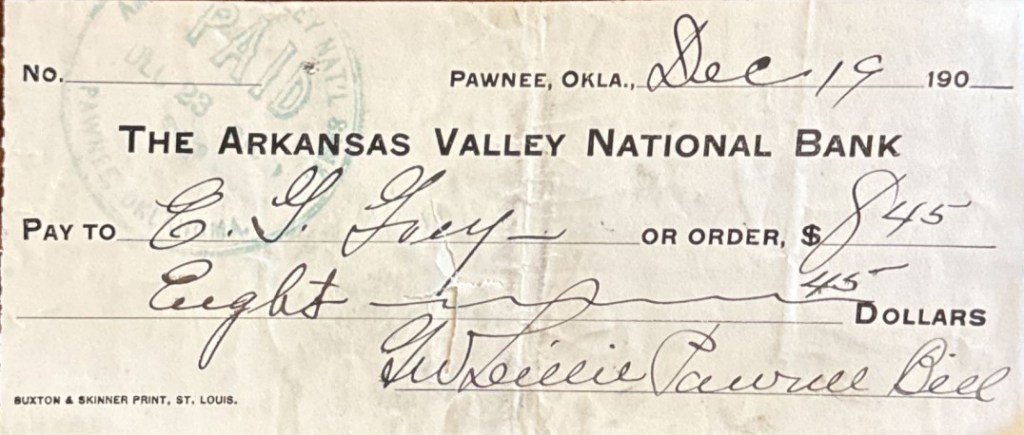
There were some mighty cool things to see in the collection. One was a letter from the U. S. Department of the Interior regarding a brief history of some of the Native American tribes, evidently confirmatory information G. W. was seeking in writing some material for promotion or justification for funding. There was discussion of potential film work; Pawnee Bill’s radio show; legal discussion with Buffalo Bill regarding an upcoming collaboration; and discussions concerning whether or not to bring a show to the 1904 St. Louis World’s Fair. It is my reading that the 1904 World’s Fair featured Cummins Indian Congress and Wild West Show, rather than Pawnee Bill.
There was a complete schematic for a show handwritten on something like wax butcher paper, like 2′ x 2′ torn off a roll, with lists of acts, entertainers, how much they would be paid, train car needs, trinkets to be sold… is was quite detailed, now loosely folded. Amazing to see!
It was great to run across a hard-bound program, called a Route Book, for the show in1898, and many of the individual performers and workers were named, but not all of them, and, no, Ed Fay was not listed. It was a year that Buffalo Bill’s show also was touring, and none of Buffalo Bill’s show was included in the Pawnee Bill book.
Another official program for September 12, 1905, a much smaller publication, mostly advertising, with program notes and acts listed on two facing pages. No Ed Fay was listed here either.
The 1898 and 1905 books yielded the only lists of performers I found in all the boxes of papers I perused. Even if Ed Fay did perform with Pawnee Bill in either year, he might not have been listed. In part, this is because not all performers or workers were listed, especially in the category of cowboy, which seemed an umbrella designation, with some exception. Then, if Ed Fay did perform in any other year of the show’s existence, we have no record of it in this collection, since only two years of the show are documented in the current Lillie collection.
Mr. Lillie would write notes on the backs of letterhead, the letterhead often more interesting than the notes. The letterheads underscored various projects of the Lillies over the years.
Many of the checks were to local businesses in Pawnee, Oklahoma, which must have been very thriving at the time, with drug stores, groceries, hardware stores, and blacksmith services. There also were checks the Lillies wrote to far-flung places where the shows had performed, like Niagara Falls and Los Angeles. The Lillies evidently would continue doing business with clothing stores and specialty wine stores that they found on their travels. There is one group of receipts from their 1913 series of shows in Madison Square Garden, New York City. The NYC receipts include blacksmith work, costuming, and a new saddle for a new star they had just hired.
It does seem that if G. W. and May needed an item, they were not necessarily inclined to go to Guthrie or Oklahoma City to get it, but often were able to purchase directly from nearby vendors, as evidenced by the checks and receipts I have seen so far.
I also learned to be aware that Words Fairs continued into the 1900’s, and to consider the exhibitions as opportunities for wild west employment where Ed Fay would have had opportunities to work.
Moving Forward
It does not make a lot of sense to research things highly unlikely to give you the results you seek. Yet, if you are not finding exactly what you hope to see, continue to keep your radar of awareness broadened to find more clues to your answer…any vendors; any shared enterprises; locations; modes of travel. Any of these observations may lead to other viable research avenues.
Continue to have a spirit of discovery and wonder, considering the lives of the people you are studying, and trying as best you can to faithfully understand the worlds in which they lived.
In the era leading up to the Osage tragedy portrayed in the book and movie Flowers of the Killer Moon, a time also that included the Tulsa Massacre, it is important to remember that Ed Fay was living in a time and a place, fairly close geographically, that was about to explode. Did he know it? What did he see? Was he disturbed by it? His maternal cousins, the Drs. Auchmoody, were to be witnesses to the Osage murders, not that far from where Ed apparently had been living. Was Ed Fay a man who had learned when it was time to move along?
There will be more coming your way, as we research some documents that suggest that the Ed Fay in Lincoln County, Oklahoma in the early 1900’s had a bit more complicated life than what we have so far known. More to come…
Thanks for tuning in!
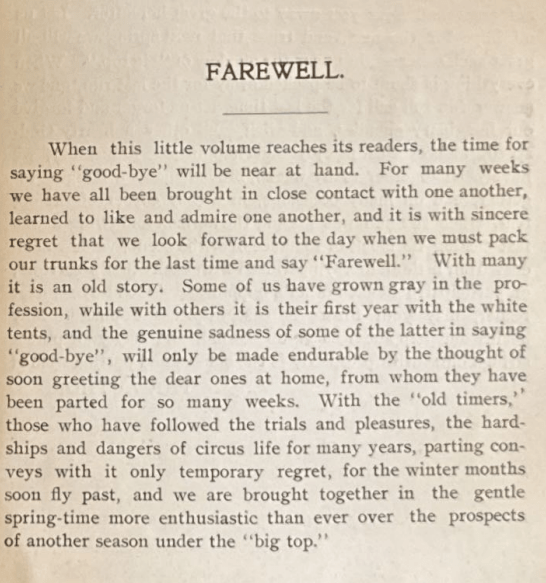
As we depart, take a look at this farewell page from the Pawnee Bill Wild West Show Official Route Book of 1898. As you read it, think of Ed Fay as a person who worked for shows with idealized camaraderie. One is struck with the writer’s sentiment of wanting to participate, belong, stay, and/or return again; but the reality that the show is, after all, just a show with no enduring commitment or promise of career.

William Williams
Citations
*Gordon William Lillie Collection, Box #3, Folder # 2, Western History Collections, Special Research Collections, University of Oklahoma Libraries, Norman, Oklahoma
**Gordon William Lillie Collection, Box #3, Folder #2, Western History Collections, Special Research Collections, University of Oklahoma Libraries, Norman, Oklahoma
***Gordon William Lillie Collection, Box #1, Western History Collections, Special Research Collections, University of Oklahoma Libraries, Norman, Oklahoma
****Gordon William Lillie Collection, Season 1898 Official Route Book of the Pawnee Bill Wild West Show, Compiled by H. G. Wilson, Published by O. J. Krause, 1898, pp. 113-114, Box #13, File #1, Western History Collections, Special Research Collections, University of Oklahoma Libraries, Norman, Oklahoma
Additional Reference
Pawnee Bill Ranch and Museum under auspices of the Oklahoma Historical Society https://www.okhistory.org/sites/pawneebill
 Ancestors Worthy the Note