

James River at Richmond, Virginia
In-the-Middle can be a cozy, happy place to be– among good friends for a celebration or cheering on your favorite team with like-minded fans. In-the-Middle can alternately be an unpleasant place to be– at best, a place of uncertainty of your spot and unable to see your way forward; or worse, between two friends who are in the midst of a vicious, hurtful, possibly inexplicable, and seemingly permanent rift.
Today we will pivot from our outlined plan of presentation briefly to talk about an issue that does arise for you, one hopes, never, or exceedingly rarely.
What is one to do when your close friend or relative asks you, explicitly or implicitly, to not associate and/or communicate with the person and, in fact, you discover that the friends have become estranged?
Depending upon your experiences, this may seem an easy question to you, but I assure you it is not always easy. In fact, it can be harsh and complicated, even hurtful, resulting in finding oneself in a no-win situation with no easy resolution in sight. How should one proceed?
Here are some considerations that may help people find their way through the dilemma.
What are the facts and revelations that have resulted in the estrangement?
Is there evidence of dangerous behavior or threats to safety?
Is there substance abuse contributing to behavior or actions of concern?
Is there untreated mental illness present?
Who may potentially be harmed or threatened by this person, and how?
Is there evidence of new concerns about behavior or boundary infractions from which individuals need to protect themselves?
Is there lying, disinformation, manipulation, and/or triangulation occurring, pulling people into conflict with each other?
Who is being threatened… the person issuing the estrangement; elders or children connected with either party; and are you potentially a victim, as well?

Richmond, Virginia Road Detail
Has there been enough time to safely gather the information needed to assess the situation, allegations, and facts?
An extreme example, for the sake of illustration: In national news recently a man, married with adult children, was arrested for alleged serial murders of several women, with more possible charges to come. By current accounts, the wife and children had no idea of the man’s behavior leading to the arrest. None of them have been to visit him in jail. This sort of discovery of information about someone you love is highly unsettling, frankly shocking, and underscores how new information about an individual can impact assessment of one’s personal, financial, and emotional safety.
Understanding the safety and security issues of all involved, of course, can help assess one’s stance in supporting and/or participating in the estrangement.
Are you able to honestly see another side to the person… to admit that your assessment of the person was incomplete, inaccurate, or just plain wrong?
Arguably, I think, one of the hardest things in life is to admit one is wrong about… anything; but especially about one’s assessment of a person.
I have seen families torn apart when a revelation, such as was described in the extreme example above, was not recognized by one or some family members, who insist upon supporting the offending party, even blindly not acknowledging the new information at hand. The danger of this lack of acceptance is obvious and often will be the reason that the party issuing the estrangement will be compelled to issue an ultimatum to friends and family in order to assure the boundaries of their safety and security, and of those for whom the person has responsibility of care.
“If you have Uncle _____ at your home for Christmas Dinner, let me know; I cannot be there with my children if he is present.” Such ultimatums are made out of a decision, right or wrong, to set boundaries for perceived need for protection and safety, at least emotional, if not physical.
What about a less-extreme example? In this case, the discovery is more about the health of the relationship/expectations/validating behavior in the offending party. Sometimes we observe others’ relationships in a new light and re-assess our interactions with that person. It can be growth to see that a relationship was not as healthy as you thought it was, that you were minimizing or overlooking unhealthy interactions. In such a case, you may choose to back away from the relationship, or approach it in a different way, based upon the new information coming from the estrangement.
CAVEAT: What about individuals who falsely assume the danger of certain individuals based upon their prejudice or bias?
There are, in some cultures and places, people with very rigid and not-well-informed perceptions about people on the basis of skin color; piercings; tattoos; hair style; religion; ethnicity; gender; sexual orientation; even affiliation with sports team (think Texas vs. Oklahoma or Vikings vs. Green Bay Packers… you get the point). If these, or similar nonsensical delineations, are the reasons a person is issuing an estrangement it makes no sense to go along with an ultimatum to join the estrangement. Uh… no!
Has there been no evidence of dangerousness, but there is an impasse and severed relationship between the estranged persons, both of whom you care for very much?
When there is no danger evident, deciding how to handle your relationship with each party in light of a stance by one or both that you should have nothing to do with the other may be harder to sort. Taking some time to assess what is happening and how best to respond can help you to take a stance. The first objective may be to process what may be a sudden event, revelation, and/or reaction. Since both individuals are important to you, you may find yourself significantly distressed.
For sure, good self-care is imperative, giving yourself space to process and tend to your needs for food intake, exercise, and sleep. Healthful ways of emotional expression can be helpful also, using journaling, art, and music to explore your thoughts and responses. As mentioned earlier, do what you can to engage to gain knowledge and discover what has happened, as best you can, safely and prudently, if you are uncertain about the circumstances of the rift.
Since there may be repercussions for you, and you desire to not exacerbate the rift, it may be helpful to speak with a neutral party to consider the situation, personalities involved, and how the situation impacts you. It can be helpful to speak with a reputable, licensed therapist; a trusted mentor; or a neutral friend whose judgement and perspectives you respect. Sometimes just speaking freely can illuminate the path; sometimes the observations of someone not directly involved can shine a light, as well. Also, once you become more calm, you will be able to engage creatively to discover ways to approach the situation and boundary parameters while still fulfilling what you believe to be a healthy way of addressing specific issues.
Getting feedback also can help you to think through what approach and boundaries you might set on the situation and what could be the potential fallout of each option. You may elect to honor the boundaries the estranging individuals have set with each other and underscore that their issues are between each other, while honestly telling each what you will, or will not, do and that your continued connection or interactions with each do NOT mean that you do not care for each of the two. In that case, you are telling them that you are not going to completely disconnect from either of them, and telling them in as honest and calm manner as possible. You cannot control the reaction of the party (parties), and it it is good to be as prepared as you can for an unwanted reaction, which is why taking plenty of time and utilizing discussion with a third party can be important. If you are fortunate, you can set forth a plan that is acceptable and will provide you some relief. Sometimes, you may set boundaries that are not necessarily articulated verbally, but are actionable for you and work well for the situation, given the circumstances.
Where does this leave us?
Not all people who are in estrangement issue ultimatums to family and friends… “You are either with me or against me.” or “if you choose to talk to ___ that means you do not love/believe/support me.” It is a much easier situation if you are told clearly why they are estranging themselves and let you know that you are free to make your own choice, but that they are issuing for themselves their boundary that they request you respect… For example, to please let them know if this person _____ is at your party, so they can decide whether or not to attend.
I think it comes down to a few key points.
Make sure you are as clear-eyed as you can be about the truth of the situation. Be aware that more information can come up, and you may need to re-assess.
Be sure to protect yourself and any for whom you are responsible, including children and elders, as best you can, and do your best to support others who are doing so.
Know that it IS possible for people to grow and change, so if people are estranged from each other now, they may make another choice later. And sometimes, people grow and heal! They go to therapy; they become clean and sober; they become more insightful. It is a good thing to be open to positive change as a possibility.
Otherwise, people’s estrangements are their own. Not yours. It helps to underscore both things.
You can respect other people’s estrangements, and in fact, you SHOULD, because it is their lives and needs they are acting upon, and you do not know all of the factors that went into their decision. But you do not have to feel responsible for them or for fixing them. From my perspective, this is a hard reality.
Some of the factors we have talked about in earlier segments and will discuss in future ones apply here too. Prayerful people may ask for guidance, clarity, and insights in dealing with their estranged people. Each of you may have skills and perspectives you can bring to the situation, helping others in similar situations navigate in creative ways. For instance, you may help friends plan for holidays, when segments of a family are estranged from each other, reminding them that it is okay to approach traditions creatively, celebrating with parties separately when possible and differently when necessary; holding and maintaining one’s joy for the meaning of the holiday; and engaging in appropriate boundaries and self-care.

Photo of trail map at Richmond portion of Captain John Smith Chesapeake National Trail.
https://www.nps.gov/people/john-smith.htm
An uncertain journey…
The James River is a navigable river into Virginia, in the lower reaches at Jamestown it is tidal and brackish, used for millennia for transportation inland from the coastal areas, up to the point of the of the river which now is the location of Richmond, Virginia. When you travel upstream by river and arrive at Richmond, you encounter rapids down which folks can kayak. How cool is that!
Currently, the James River at Richmond is a destination for tourists, but it is highly utilized by local residents to hike, bike, and play. It is best if you know the area, how to get there, the location of the various trails, and where to find your way to what you want to experience. If you do not know where you are going, you may find yourself in the middle of discomfort and confusion. There is more than one land mass or island; there are bridges, some of great expanse, to take you from one land mass to another; it is not always clear at the outset if the bridge you have set upon will take you where you want to go; and distance and time estimations, as well as the nature of the path forward, are not easily discerned. At least one bridge, while semi-pedestrian friendly, actually is for delivering motor vehicles to the other side of the river, and it is quite a hike on foot. If you have plenty of water, the weather is mild, you have no timeline, you are in good physical shape, and you are not hauling your luggage with you and wearing dress shoes because you are killing time before you head to the airport (true story– I met someone on my adventure exactly in this situation), you will have great exercise as you enjoy a lovely and historic setting.

The discomfort of not knowing the trail routes; hoping you have enough water with you; and hoping you do not have to retrace your steps to return to town reminds me of some of the feelings and experiences of being in the middle of an estranged relationship between friends.
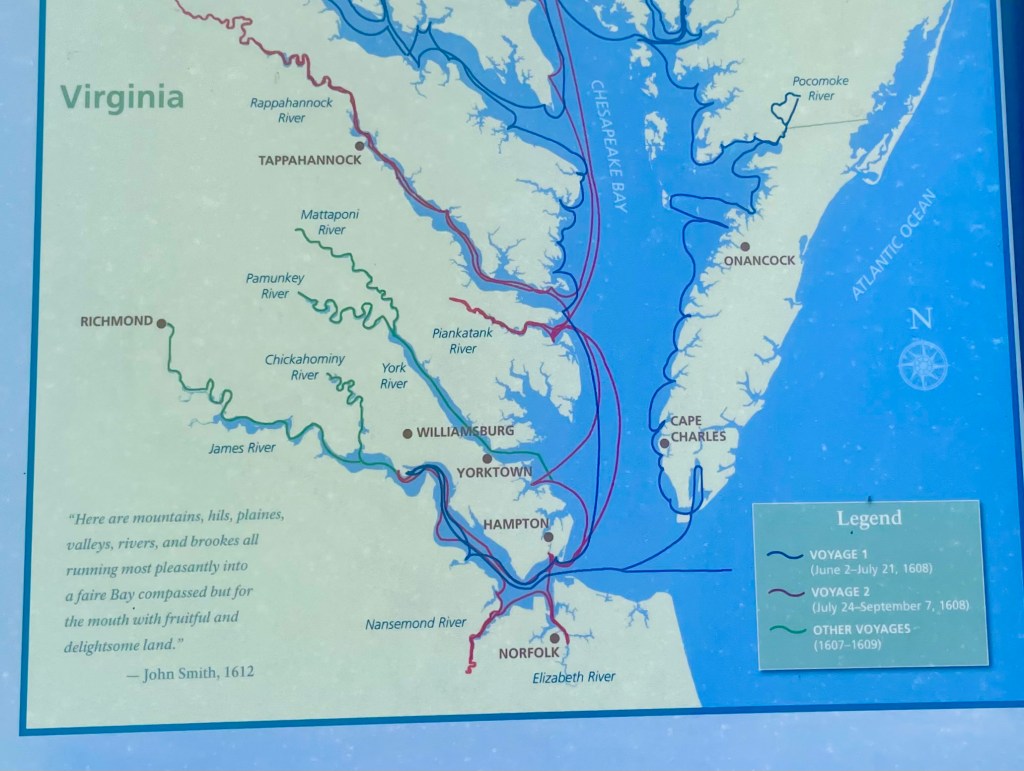
James River in Richmond, Detail https://www.nps.gov/people/john-smith.htm
The similarities include being surprised, perhaps, at your lack of good information about your situation; having limited control of your circumstances; and not knowing how long the uncomfortable situation will last. At least on a hike, you can be fairly sure there is an end point, regardless how taxing it may be, and to some degree, that end point is within your control, if only because you continue to press onward.
How, when, or if the estrangement between your friends ends, may you continue to find healthy boundaries and self-care as you continue to be a friend to the parties, as best you can be, as long as it is healthful or prudent to do so. And when you cannot continue an active friendship, to wish them well in your heart and pray for continued healing of all concerned.

Street Art at James River Waterfront, Richmond, Virginia
How, when, or if the estrangement between your friends ends, may you continue to find healthy boundaries and self-care as you continue to be a friend to the parties, as best you can be, as long as it is healthful or prudent to do so. And when you cannot continue an active friendship, to wish them well in your heart and pray for continued healing of all concerned.
William Williams
 Ancestors Worthy the Note