Our adventure was limited by some key factors. It is low tourist season, and many sites are closed for the season, especially the lighthouses. Several museums and the Cape Hatteras Lighthouse are closed for renovation. It is holiday season, adding to closures and changed schedules. It is winter, so cold and windy on the outer banks of North Carolina, which led us to hang indoors or not venture so far away from shelter, when normally we might have taken longer hikes.
What we did experience, wherever we went, was to engage with people and encourage them to share what they knew of the locations and history of the outer banks. Some of our favorite locations for finding information included the following:
Fort Raleigh National Historic Site, Roanoke Island
Poor Richard’s (Poor Rudolph’s) Sandwich Shop and Pub, Manteo
Wright Brothers National Memorial
Outer Banks Visitors Bureau, Kitty Hawk, NC
Currituck Banks Maritime Forest Trail Lookout
Corolla Wild Horse Fund, Corolla, NC
The Kind Cup coffee shop, Corolla, NC
The Island Bookstore, Corolla, NC
Absolutely Outer Banks, Kitty Hawk, NC
Knitting Addiction, Kitty Hawk, NC
Outlets Nags Head shopping center, possible location of original Port Roanoke during time of sea inlet in the North Carolina outer bank at this location. Looking west across Albemarle Sound toward Roanoke Island.
We enjoyed speaking with park rangers, a retired wildlife management person volunteering at the Currituck Banks Forest Trail, and residents who shared their stories and information. We found maps, books, encouragement, and a shared love of the location and its multiple layers of history. We continued to find very few people who had knowledge of the early sea inlets of the outer banks. One resident believes that the original Port Currituck is at the location of the current Currituck Lighthouse, which is in the old village of Corolla, NC on the north end of the outer banks, at the current end of the road north, where the Corolla wild horses now reside and are protected.
Wright National Monument, Kitty Hawk, North Carolina
Geographical Take-Aways
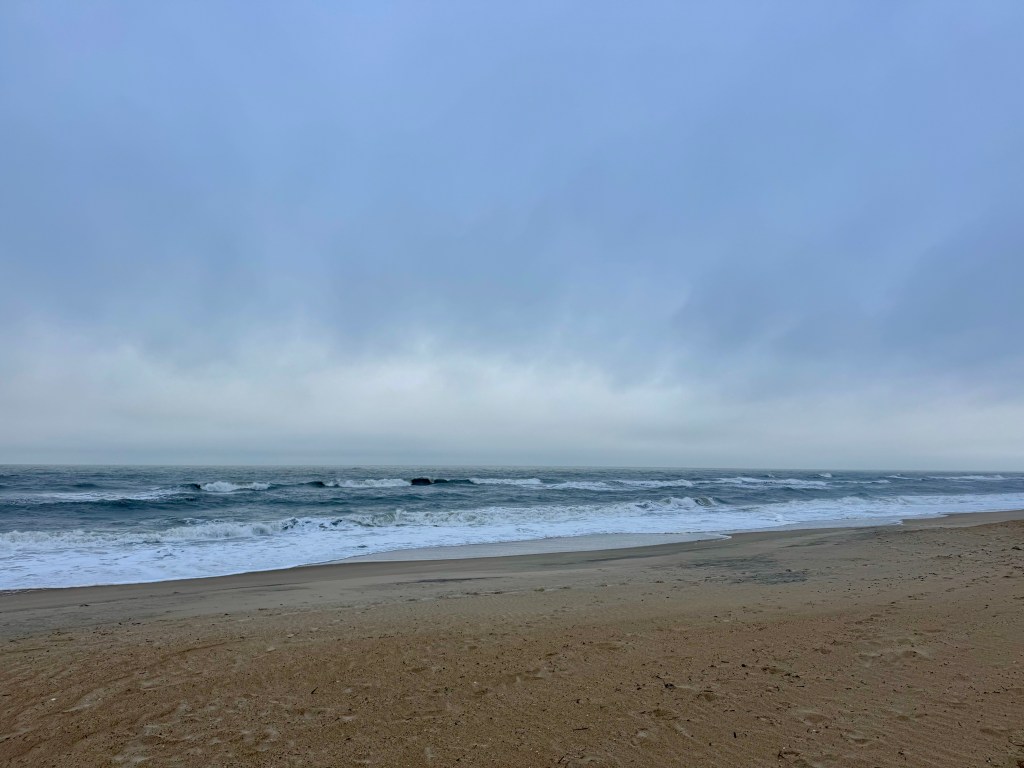
Inclement yet beautiful beach weather, Kill Devil Hills, North Carolina
In my mind, as we planned the trip, I thought we might venture to more locations of interest… Elizabeth City, Currituck, Cape Hatteras, or even Northampton County or the Great Dismal Swamp. Spending more time in the car just sounded like NO fun, so those excursions will have to wait until another day. All of this continues to underscore how hard travel is in this part of the country. Everything is so far away, and so dependent upon bridges, which did not exist until 1928. Understanding how people traveled from this location to West Tennessee in the 1830s is still a topic I am keen to understand, and I look forward to discussing the topic with researchers who have expertise in early migratory patterns of eastern NC.
Here are new-to-me ideas that I am considering:
The height of dunes
That the Carolina outer banks dunes build up from southeastern winds and are taken away by northeastern winds
The consistent prevailing winds
That other than Native Americans, there were very few people on the outer banks until after WWII
The brackishness of the Albemarle Sound water shifting with the presence of sea inlets vs. their absence, which impacts type of fish and fowl present for hunting
Jobs for people shifting with the season, depending upon temperature and weather conditions impacting available fish/clams, and this would have been true also for indigenous peoples
The many rivers emptying into the sound at various points underscoring the relative ease in early history for waterway travel vs overland travel, especially prior to bridge construction
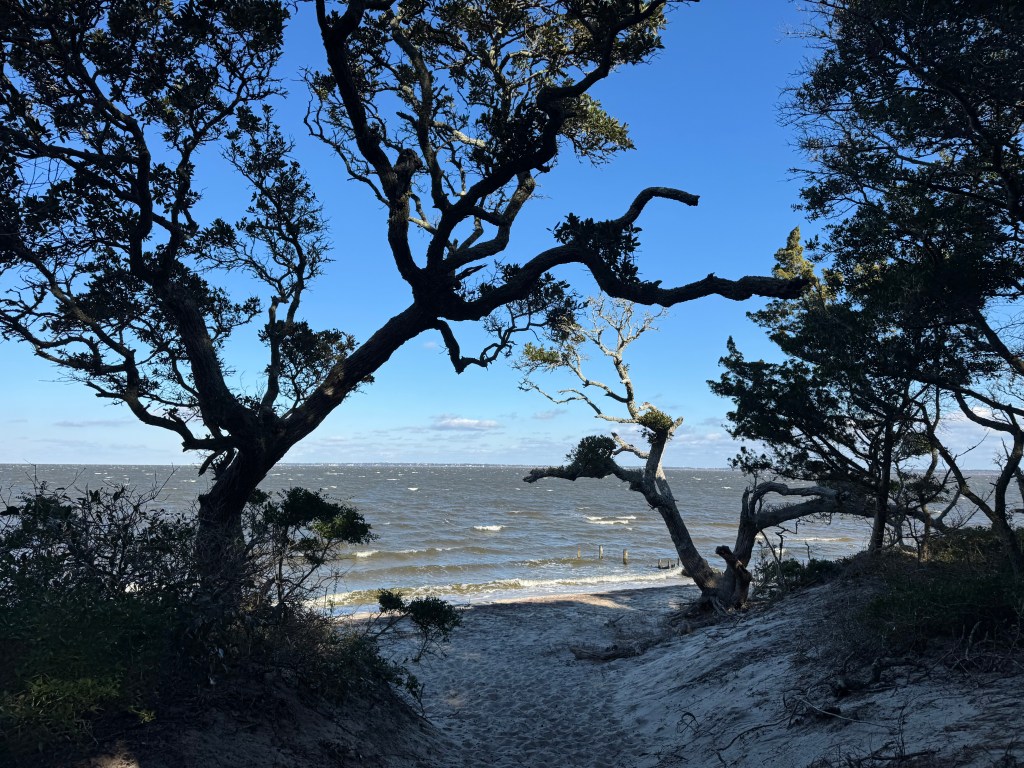
View of Albemarle Sound from Roanoke Island, Lost Colony
Successful Adventure
I can say, once again, that travel to see an location in-person has advantages over simply reading about the area or doing online research. So far, there is no huge revelation or break-through to report this trip. It would be unrealistic to expect such miracles for every trip. Yet, it is easier to understand what I read and research about the location and its history, now that I have visited. I can contextualize the information I acquire. It also may be easier for me to pose questions and theories that are sensible, and to locate the researchers/information I need to further my understanding and acquisition of data.
The Central to Northern Outer Banks of North Carolina (OBX) during winter months was a fun trip and worth the effort.
May all your 2025 adventures be all you hope, for connection, experience, enjoyment, and fulfillment!
The adventure is underway! The mission is to spend time in the Outer Banks of North Carolina, mostly as vacation, but also to experience the area that hosted the ports of Roanoke and Currituck in colonial times until 1800.
We drove from early morning until evening, and since now it is winter, it was dark when we left and dark when we arrived each day at the next location. Even though this is a road trip, I would not consider it a leisurely one, but rather a hard push, because that is the way we roll… eager to get to the destination! We traversed the full length of three states to get to the North Carolina Outer Banks.
Yesterday was our first full day here, and it was cold with periods of heavy drizzle and rain, but will be the warmest day of our stay. Today the sun is shining, though cold and breezy with 27 mph sustained winds and a high of 43 degrees F. Tomorrow will be even colder with 36 degrees predicted for tomorrow’s high. Maybe we understand now why this is low season for Outer Banks tourism?
We explored the northern reaches at Corolla and Currituck County, and we have been to Roanoke Island. I am processing what I have experienced and seen, and now I will share my points of contemplation, so far.
The states of Tennessee and North Carolina are really, really long. With newly uncovered legal documents that cite Jefferson Thomas Williams (d. bef 1870, Fayette County, TN), I need to retool his timeline to understand how his move from Northampton and Warren Counties in North Carolina to Fayette and Haywood Counties in Tennessee transpired 1830-1840. Was it one, one-way move, or were there some trips back and forth, and how did he, his wife Nancy Daughtry, and their son James L. Williams travel?
Is there any chance that they used river or sea routes, like to the Mississippi River from Kentucky and Missouri and downriver to Memphis, or to through the Albemarle Sound to New Orleans and up the Mississippi? If they did use waterways, would there be any yet existing documentation of their trip?
Asking questions about the colonial era Great Dismal Swamp or the early ports of Currituck and Roanoke tend to provoke surprise and often confusion. Evidently, the era/subjects are not common questions for park or visitor center workers. So far, I have found no printed material about the ports. It is fair to say that the average person has no idea about existence of the original Port Roanoke.
As when visiting Rome or Greece, even the eastern American seaboard exhibits evidence of many layers of history from the First Americans of indigenous origin through to modern times. I am reminded that some North Carolina genealogists have been frustrated that much of the regional research focus for decades was upon the Civil War and the periods just preceding and following the conflict. Common surnames and lack of digitized or centralized early records made it too difficult to research, with any success, families and individuals in the Carolinas and Virginia during colonial periods. Recent advancing technology, computer/digital/information sharing/DNA, brings more information for us to reliably examine.
There is a need to look further at modern researchers doing marine archeology in the Albemarle Sound, the tributaries, and Outer Banks. We also should encourage more research.
We need to do more study of the North Carolina State Archives online digital records and do further analysis of the colonial and early United States Outer Bank port information showing the parties, products, and vessels and what we can learn about the families, individuals, and locations cited.
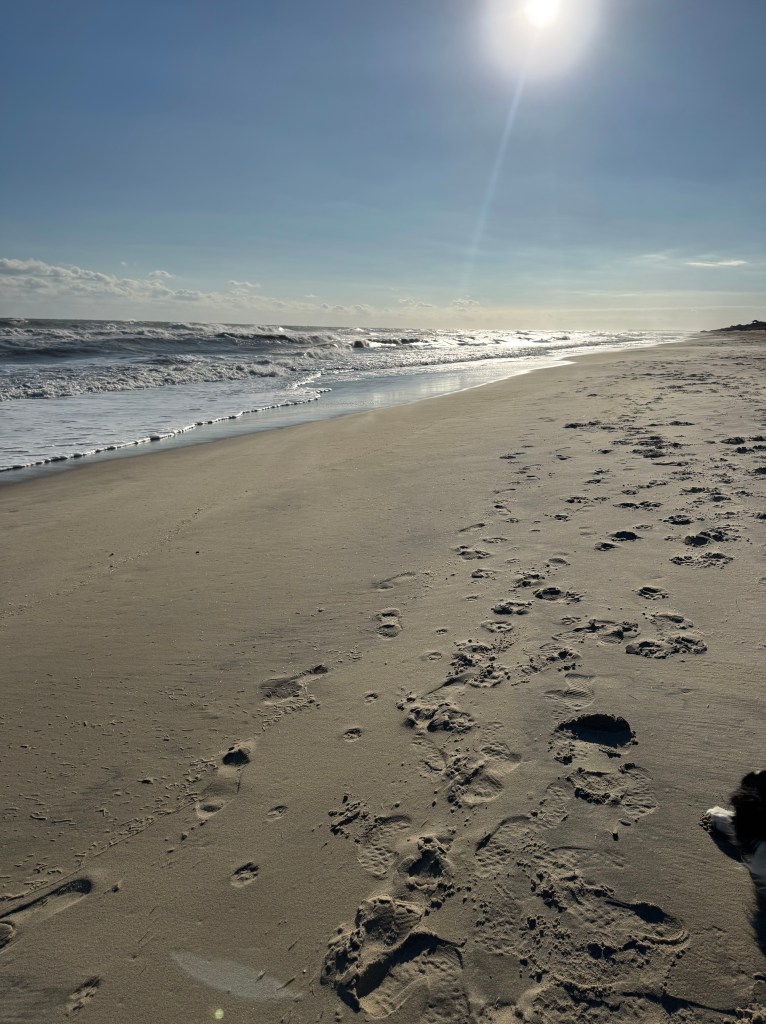
Walking on the beach, even with moderate/normal conditions, the blowing of the sand is impressive, making it possible to appreciate how the terrain shifted over the years to open or cut off outlets from the Albemarle Sound into the ocean for sea-faring vessels to traverse. We note that the Wright Brothers National Monument at Kitty Hawk, is on a high point that was once a very high dune used by the brothers to test their gliders. In order to stabilize the dune for installation of the monument, workers planted vegetation… it does take work to keep any earth in place here.
The breezy winter conditions are a reminder of the wisdom of the Jamestown and Roanoke colony originators that the actual coast/beach would be a difficult place to establish a community. A bit inland would be better. Having visited both Jamestown and Roanoke Island now, I think Jamestown was more wise… After today, I had a hunch that if I were one of the original Roanoke Colony settlers of the 1580’s, the ones who disappeared and whose fate remains a mystery, I might be thinking of moving farther inland too. Just saying…
I visited the Outlets Nags Head today at 7100 S Croatan Hwy, Nags Head, NC 27959 , the place along the Outer Banks that, I read prior to my trip, is a likely location of the original Port Roanoke where, at that time, there was an opening through the banks deep and wide enough to allow access from the sound to the sea. Now, in common parlance, “Outlets” refers to a retail-shopping outlet mall. Do you think the potential double entendre of *outlet to the sea* was intended when naming Outlets Nags Head? I wanted to ask someone at the mall if there was an awareness of the colonial Port Roanoke port having been at the location, but I found no one official to ask, much less to inquire about the name. Tired for now of people looking at me funny, I did not ask the store clerks busy with holiday shoppers.
Thanks for following along. More observations as they come!
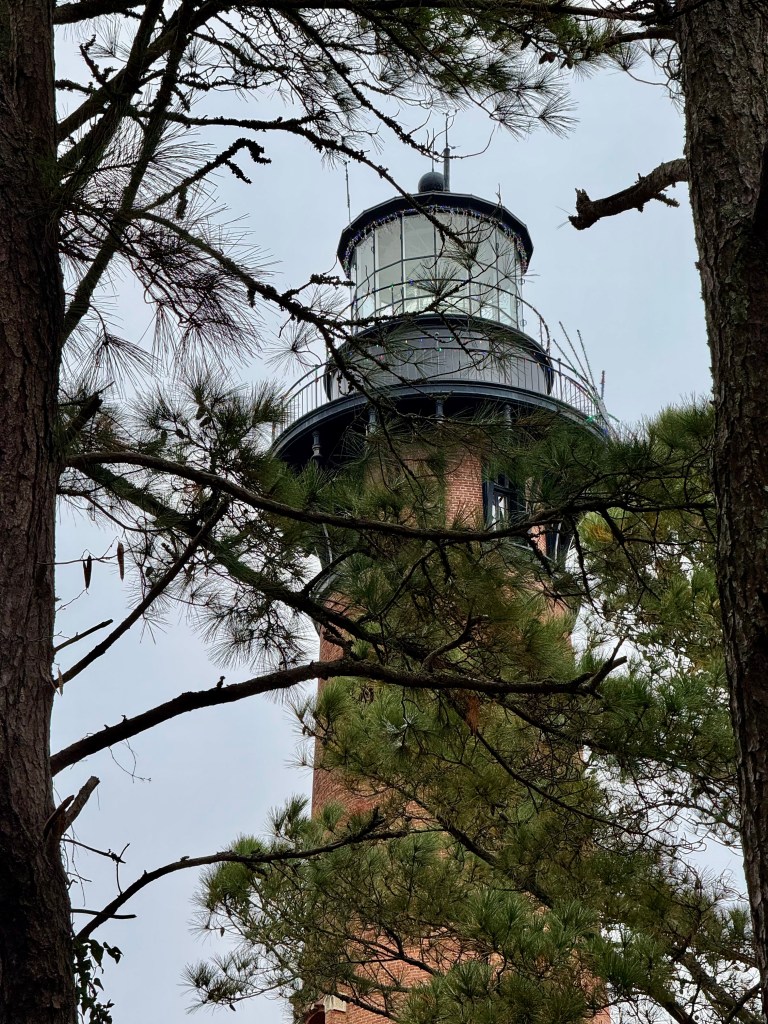
Currituck Lighthouse at Corolla, Currituck County, North Carolina, built in 1875
From reading my prior blog posts, you can probably surmise that genealogical trips are not a new thing for me. I have enjoyed traveling to genealogy workshops, courthouses, libraries, archives, and museums. I have gone solo, but alternately have brought along my spouse, willing and available family members, and have met up with DNA-found cousins for these adventures.
One dominant and, to me, unpredicted take-away about my trips is that seeing and personally experiencing a geographical location gives me information that I cannot get online. I cannot tell you in advance what I will find. Sometimes it is a clue or fact, like evidence of a name or a photo of a house, or an actual house that was owned by an ancestor, found in an old city directory that is not online.
Sometimes it is a geographical feature or land formation that is unique from what I imagined or have experienced. I confess, I had to actually see the Grand Canyon to truly appreciate the vastness of it. Hiking the Great White Sands, at the encouragement of my spouse, despite my hesitance, allowed me to appreciate the three-dimensionality, shifting topography, and challenges in navigation without GPS or compass. When researching ancestral migrations, seeing and experiencing the actual locations can give clues for understanding how they lived and functioned in their daily lives; why they moved to another location; obstacles to transporting themselves, their possessions, and any products; and therefore, other potential sources of information about the ancestors or their friends and family.
There are many who will tell you that before setting out for a genealogy expedition, in order to make the best use of your time, you should fully research your destination, making sure the locations will be open and accessible to you; that you identify what you want to research onsite, since many items are available online anyway; that you have been sure to check ahead that items you want to see are not currently stored at an offsite location or off rotation due to upkeep; and to have your notes prepared for quick access to maximize your time, etc, etc. There is more prep to share, but you can find all that advice elsewhere.
For a different experience and blog series, I am going to share with you as I proceed to the Outer Banks (apparently, commonly OBX) of North Carolina, a location to which I have never been. Acquaintances have been to the OBX for annual summer vacations, and I always found it fascinating, since it was never on my radar. Over the past few years, it has become evident that several ancestral lines of interest were in Northeastern North Carolina from colonial times until the 1830’s, particularly Northampton County adjacent to Hertford County, North Carolina. Many of those families eventually located to west Tennessee, especially Haywood, Fayette, and Obine Counties. Sorting the different haplogroup lines of Williams, particularly, have led to examining land and probate records. Then recently, the North Carolina State Archives published existing records of colonial era sea ports of North Carolina, which deepened my fascination with the area and my desire to understand the function of the Albemarle Sound, the Chowan and Meherrin Rivers, and their functional relationship to the northern portion of the NC Outer Banks.
I am going to break a lot of my normal blogging rules to document my upcoming excursion.
This trip is more about relaxation with family and canine companionship than about genealogy
Little planning has gone into this trip. And I refuse to care about that.
Normally, each of my blogs is a research paper, written with care before posting. This time, I will write quicker summaries, in keeping with the fun/downtime nature of my trip and desire to be connected with those sharing my adventure, and also documenting my experience to inspire others to genealogical travel.
I will be experiencing the OBX as a modern-day visitor, while imagining what it could have been like in the 18th century. Can that be done? Not sure, but seeking historical maps; experiencing the ocean/marine life/weather conditions/flora and fauna surely will help me connect with our ancestors’ experiences.
Thanks for following along, and thank you for your grace in what may be spotty coverage. I anticipate posts at least every 4 days, maybe more frequently. Due to my blog plan, there may be more typographical errors than usual. I appreciate your forbearance. More to come!
NOT the Outer Banks, but where our Williams were by 1875, the foothills of the Ozark Mountains in Arkansas.
Monnet Law, University of Oklahoma, Norman, Oklahoma, USA
Aren’t we done with researching Ed Fay already?
Well, no, we are not *done* with Edgar Fay. In genealogy, I am not sure we ever complete our research on a person, since I doubt it is possible to learn everything about any individual. Usually we cease to pursue when we are out of easy research sources; harder research sources are more difficult to access; the likelihood of finding information is significantly less than the effort required; or, another, competing research interest or genealogical subject captures our attention and energy. We only have a so much time on earth to do this research, so we are wise to strategize to make the most of our efforts.
With Edgar currently, specific, pertinent research sources are more difficult to pinpoint and access, largely because the obvious online, digitized options have been investigated, and beyond that, we do not know geographically exactly where we should look. Consequently, with each potential option we approach, we must consider a cost/benefit analysis of effort vs. likelihood of helpful research findings.
Here are some remaining major research questions regarding the life of Edgar Fay. Most focus upon the missing time period of 1893-1917, as well as his disappearance after 1930, which we have not fully tackled in our blog, pending more research. From this point forward, research will be with an eye toward clues for each of the time periods simultaneously, realizing that work and connections Edgar had earlier in his adult life could also have influenced his choices and strategies in finding work in the 1930’s.
What evidence can definitively tie the Edgar Fays in our Finding the Mysterious Edgar Fay, Part 3 to the Edgar Fay who grew up in Morrison M. and Cynthia Fay’s home, left home in spring 1893, then married Mellie Burns in Clark County, Arkansas in 1917? We found several pieces of evidence for Ed Fay mining and working in livery stables in Colorado, then living in Lincoln County, Oklahoma in 1910 (U. S. Federal Census). Which of these, if any, are “our” guy? It is great circumstantial evidence, that can tie Ed to Mellie, whose maternal grandmother and great-grandmother were living in Oklahoma City 1900 until their deaths, but can we find more definitive facts to connect the couple?
Is there evidence of Ed’s employment?
Is there any evidence of an earlier marriage or other family connection for Ed?
Is there any evidence of other names/dates of birth Ed may have used?
What became of Edgar Fay when he left to find work after 1930 and did not return home? Is there evidence of any employment in the 1930’s that would substantiate our theory of his continuing to find gig work in the entertainment and/or horse riding or horse-tending/training businesses?
Source of Potential Importance
Part 3 of our Edgar Fay series was written during the beginning of the pandemic, right after a deep dive into the Tompkins papers at the Oklahoma History Research Center in Oklahoma City, Oklahoma, which highlighted a couple with connections to Wild Bill Cody’s show and their personal wild west enterprises in Oklahoma. Even as I left the center, I was captivated by my becoming aware of a trove of papers of Gordon William “Pawnee Bill” Lillie, a friend of the Tompkins, at the Western History Collection on the campus of the University of Oklahoma in Norman. I had called the site of the collection to verify availability, hours, and process for research when everyone’s course dramatically shifted, with no travel, no research anywhere, a condition that persisted for quite some time. Some would say things are not entirely back to normal, or at least procedures have shifted permanently, in some ways, for the better.
I am happy to report that last month I completed my 2nd day of research, across two weeks, at the Monnet Law building, the former home of the OU law school, which officially houses the Lillie Collection. I also plan to return to look at other sets of papers that may yield clues.
This writing is my chance to document my recent findings and my process, both worth reflecting upon. Not all of the practices I will describe are exclusive to my research, nor are they the only tips you may be given by others, but they are “pro tips” reflective of my experiences. The following practices apply not only to libraries and archives, but also to locations where court/legal/land documents are maintained. Assume that each research location has a policy and practice unique to that institution, even within the same state, and even within the same county.
How to Approach
Remember that not all facilities are set up for researchers or genealogists; they may be functioning court houses where staff are not particularly oriented to the needs or requests of a researcher.
The distance you will have to travel to an archive makes some difference in how you approach your mission.
Are you familiar with the area geographically?
Will you need to research for several straight days, if you are traveling a long distance?
How large is the archive, and is there a feel for how long it will take to accomplish your research? Know that going through a box of cancelled checks may take much longer than a box of show programs, not only with respect to quantity and size of items, but challenges in deciphering the writing.
Check the website.
Familiarize yourself as much as you can about the collection. Is there a list of what is contained?
Is there a process listed for contacting the archivist about the collection and requesting a visit?
Contact the researcher/librarian.
Do not assume that all the instructions and availability of items are accurately depicted on the website.
Do your best to make your contact with the archivist as directed on the website. Sometimes there is a form to submit as a query; sometimes there is a live chat available.
Verify availability of the files/collection you want to see; hours and days of the week they are open for research; and if they will be open on the day(s) you plan to travel. Additionally, a facility may allow only a limited number of researchers at a time, and you have the option to make a reservation.
In my experience with the G. W. Lillie Collection, the entire collection was out of circulation for maintenance, and therefore unavailable for several weeks/months.
The archivist offered to take my contact information and inform me when it was available. There are still a couple of boxes not available that I may want to see later.
Verify the process by which you will request the specific files/boxes to be reviewed.
The archivist may send you, by return email, or send you to a web-link describing the process for requesting, usually just so many boxes at a time, and how/when to request more. Often, the files are stored off-site and must be transported.
You may be required to reserve a time slot for research, and these may fill quickly, so do not delay to check on your options, particularly if you only have specific dates available to research.
Be aware that each location has stipulations for accessing, including use of cell phones or not; pens vs. pencils (almost always pencils); availability of copy services; how to pay for copy services, possible options including cash, credit card, or refillable smart card. Be prepared to have loose, blank pages of paper and pencils with erasers; a folder to hold the paper may be allowed.
Ask about requirements to access the records, including registration as a researcher or procurement of a library card. Some facilities only allow in-state residents to access the facility’s records. Others may allow guests who must apply for a card in-person.
Be aware of limitations of posting photos of items within a collection on your blog or website. They often are protected with some sort of copyright or protected arrangement, sometimes by the donor of the papers. The archivist can give you guidance regarding requirements for the collection in question.
At all times, of course, treat staff with the utmost courtesy.
Some are permanent staff; others are volunteers or students. Any will be as helpful to you as they can, within what they can and are allowed to do, given time constraints and any regulations in place.
Sometimes volunteer staff do not understand the backstory or reasons for the policies, so are at a loss to explain them. Just know that fragility of records, privacy concerns, and donor stipulations cover most of the rational.
Check other resources for important information about how to carefully handle documents, keeping them in order and handling minimally. Use the same care that you would give to archival photos.
Target the boxes/files most likely to have the information you will find beneficial to your project.
Get recommendations from the archivist for parking options near the facility and any extra instructions for arrival.
Gearing up for the day, with refillable water bottle in tow, awaiting the morning’s opening of the collection, reviewing names from genealogy file. Grateful for college campuses near walkable neighborhoods.
Personal Considerations
Do your best to care for yourself. When you drive a long way, it makes sense to work for an extended period of time. Especially if you think you can accomplish all the research in a day, you may consider more of a marathon approach, if you can handle it.
Arrive early to find your parking and locate break/coffee/lunch options.
Even the second day that you travel to the facility, when you think you know where you are going, your GPS may take you somewhere you did not intend, requiring you to re-calibrate and arrive a bit later than you intended. Yes, it happens.
Arriving early the first day lets you locate where you are going and plot the surrounding area for rest rooms; water replenishment sites; eateries and menu offerings for coffee or lunch.
A college campus may yield a library or union; older buildings and court houses are less likely to have many services; there may be public restaurants within walking distance.
Bring a reusable, sealed water bottle that you can stow while you are researching, but have handy for break time. You can always step out of the area into the hallway, or outside, to refresh yourself, and many facilities do have places to refill your water bottle. Having a packaged protein or power bar handy is a good idea, in case you are thick into your research and do not want to take a long break to fetch food.
Take breaks and walk around as you need.
Prepare for the likelihood that you may not be allowed to have at ton of gear at the research table, but rather will need to stow in a cubby that may be unsecured. Keep minimal credit cards and your ID on your person, and avoid bringing anything else that can be stolen.
Dress business casual… be comfortable, but look somewhat professional. Cargo pants are pretty handy, this researcher has found.
Consider having a scanning app on your smartphone, such as SmartScan Pro. After you scan items, you can upload to files on your preferred cloud account and rename the files so you can identify them. The quality of the scans via the app is excellent, as long as you check to be sure your settings are good and make sure you check the most important items, as you scan them, to be sure you are satisfied with the images
If you are using your phone a lot for scanning, bring an external battery pack to recharge as needed.
You might have a large, black handkerchief and a portable light in your car trunk in case the lighting in your facility is very poor. The handkerchief is to lie flat with the document to be scanned on top, providing contrast for the edges of the paper as you scan. The light can be placed to minimize shadow. Of course, be sure these items are allowed by the facility.
I have been in some court houses that did not allow ANY cell phones in any part of the court house, at all… even in archival storage areas. I have had to run back out to the car to lock my phone in my trunk. The rule was due to a judge’s opposition to smart phone use in the courtroom, I was told, despite the fact that the ruling applied well beyond the courtroom.
Make notes of what boxes you have researched, and if you find something, in what file in what box can it be found? You may need to return to it sometime, and/or you may need to use the specific location of the item as documentation citation.
Of interest– the archivists on staff may not have expertise in the particular area you are researching, but only regarding knowledge about the collections in the facility. If you are fortunate to be able to converse with the archivist(s) and explain your areas of interest, you may learn of other materials in their facility that may be helpful to you. Still, sometimes, you may need to ask directly about specified collections, “Do you know where the ____ papers are held? Oh, really? You have those too?!”
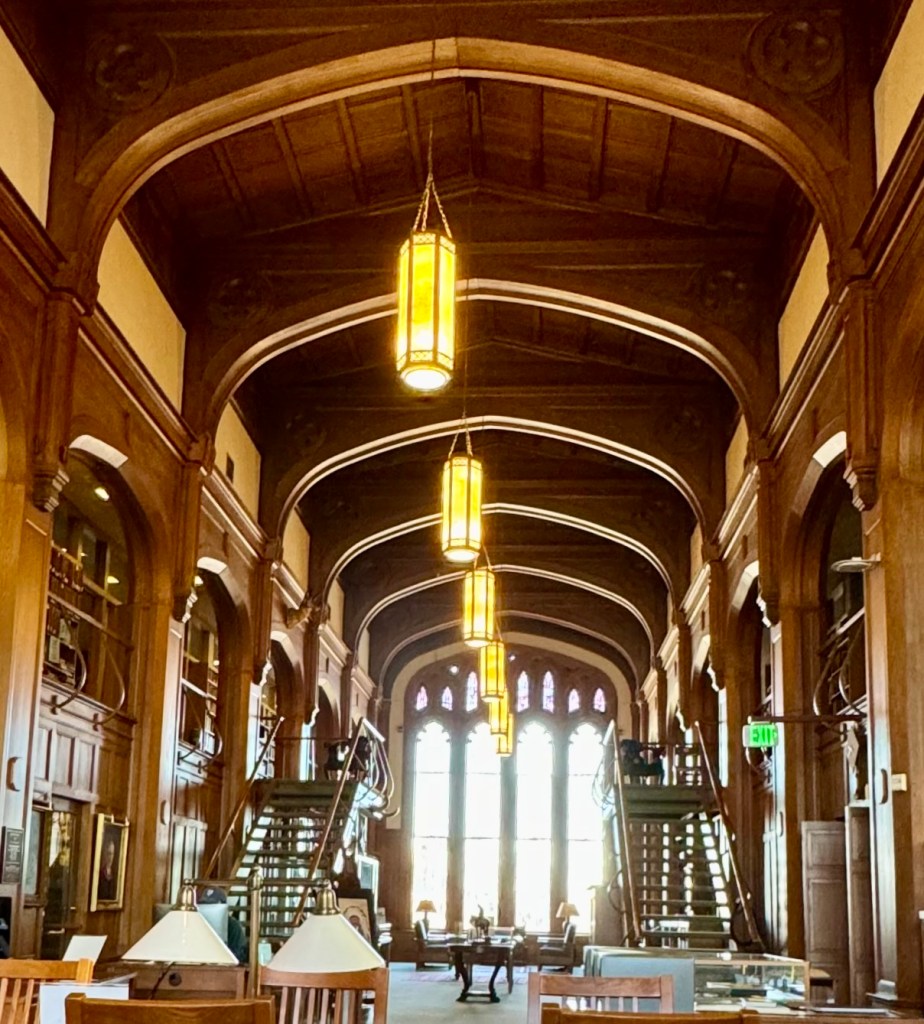
Interior of Monnet Law, an historic building that housed the former OU Law School, currently housing the Western History Collections.
Why Pawnee Bill?
As a reminder, a Fay family history/story was that Ed Fay worked for some sort of circus or rodeo, prior to his 2017 marriage. As we put together the timeline for his disappearance, it became clear that in 1893, the year that Ed, aka Wooster A. Fay, left home, the Chicago Exhibition was in preparation, and Buffalo Bill Cody, whose ranch was not far from the location of Wooster’s home and school, was reformulating his entire wild west show, which ultimately performed in an area adjacent to the Exhibition for most of the duration of it. In that era, circus/rodeo/wild west show were synonymous terms, with overlapping acts. Many of the individuals who performed with Buffalo Bill went on to have their own shows or ranches, and to work with other shows, all of which were seasonal work. Many of these individuals had serious ties to Oklahoma, either wintering in or establishing ranches and permanent shows in Oklahoma. Oklahoma City and areas to the northeast, so far, are the preferred locations I have found. All of these are near Lincoln County, Oklahoma, where a “single” Ed Fay, age 30, was working as a farm hand for a family in the 1910 census. Location of his birth as Iowa and identification of the birth states of his parents as New York and Iowa seem to point to our Ed, although his father’s birth place should be Ohio. Since the father’s family had moved to Iowa when Morrison M. Fay was young, Edgar would have known of his father and grandfather residing in Iowa where Edgar was born; and Edgar left home as a youth, so he may not have realized the Ohio birth state fact. Additionally, census records are notoriously inaccurate as primary sources of prior residence.
Pawnee Bill, whose real name was Gordon William Lillie, developed his wild west show after leaving the employment of Buffalo Bill. Afterward, the two men did joint shows, Buffalo Bill’s Wild West and Pawnee Bill’s Great Far East Show. G. W. married May Manning, who became “Champion Horseback Shot of the West.” There is a lot to be said about G. W. and his wife, and I am very generally summarizing, but I do encourage you to read more about them. For our purposes, it is important to know that, in addition to their traveling shows, the couple were involved in running a ranch and enterprise near Pawnee, Oklahoma. G. W. had a history as an Indian Scout, and he had close relationships with Native Americans, particularly the Pawnee, having served as interpreter. He was a promoter of the Wild West mythology, partly for promoting his shows and ranch, but also for the economy of the area. He for a few years he had a retail store in a store in Oklahoma City that was an outreach of his Pawnee, OK ranch, selling Native American and western items. He also was involved in gas and oil; land; and the Oklahoma state highway commission, championing Highway 64. His civic and economic development interests at times involved Fort Smith, Arkansas, particularly regarding his encouragement of highway development to promote tourism. Not all of his enterprises were successful. Several of his shows went bankrupt, and this mixed success was not uncommon among the wild west shows across the owners/operators of the genre. Gordon William “Pawnee Bill” Lillie was a major figure in the wild west enterprise, in business, and in the growth of Oklahoma generally, particularly in the first half of the 1900’s in Oklahoma. That his location was so close to Lincoln County, Oklahoma leads us to look toward the Pawnee Bill enterprise for evidence of connection with Ed Fay.
Letterhead for National Frontiersmen’s Association, Gordon W. Lillie, President; headquartered at the Goldman Hotel in Fort Smith, Arkansas, date unknown, Courtesy Western History Collections, Special Research Collections, University of Oklahoma Libraries*Example of letterhead affirming connection with Fort Smith, Arkansas, Allied Good Road Association, including U.S. 64 Association, with Major Gordon W. Lillie as President, and U.S. 71 Road Association, Courtesy of the Western History Collections, Special Research Collections, University of Oklahoma Libraries**
Taking a look at G. W. and May Lillie’s financial records and correspondence, as well as any lists of entertainers they employed, might show evidence of hiring Ed Fay at some point… assuming they wrote him a check and did not pay cash. That they would have paid an entertainer cash seems more likely… but checking the records seems worth the effort!
One “box” containing business records of Gordon William and May Lillie
Findings for Ed Fay in the Gordon William “Pawnee Bill” Lillie Collection
Bottom line, really I found nothing specifically referencing Ed/Edward/Edgar/Wooster/W. A. Fay or Faye. Still, I am beyond glad that I went through the collection. I will explain how these findings illustrate the genealogy maxim that a lack of positive evidence is not proof that an event did not occur. This is true of someone not showing up in a census, and certain is true in the circumstance of a trove of documents, that are, though interesting and informative, not a full documentation of an individual’s work and records. I also will highlight some of the findings that we can consider going forward in our research for Ed Fay.
More than one box contained stacks upon stacks of the Lillies’ individual cancelled checks and books of check stubs. I was interested in the era 1897-1939. While 1917-1939 was less likely, I am still considering that Ed Fay was always a gig worker since first leaving his parents’ home, and that if a time-limited job paid well, he might have taken it, even after he married, and certainly during the Great Depression of the 1930’s.
My search through the Lillie cancelled checks and stubs suggests that, as a rule, individuals who worked directly for the shows were either paid from another account we do not have represented in the collection, or, more likely, performers and show-related workers were paid cash. So, just because we do not have a check for payment to Ed Fay in this collection does not necessarily mean that he did not work for the Pawnee Bill show at some point.
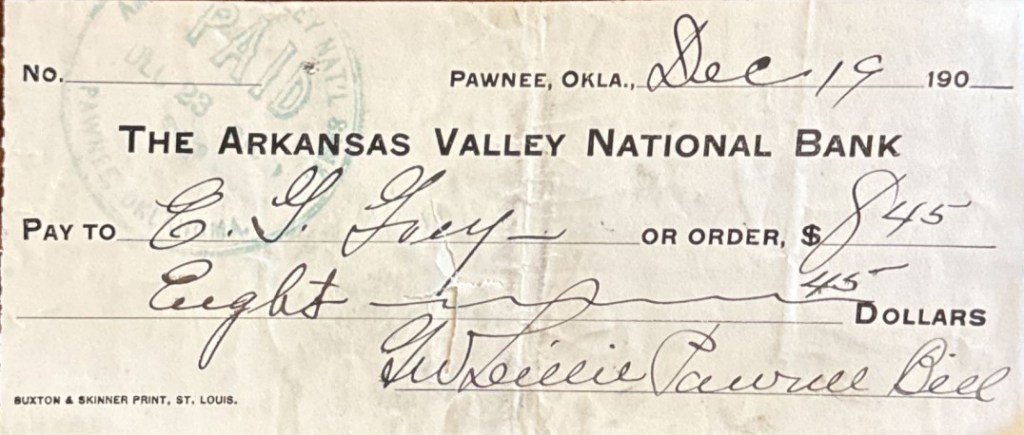
I focused upon Lillie materials that would show employee records, lists of entertainers, and correspondence regarding planning shows and hiring for those shows. I found one check that was to an individual I have come to decide is “E. G. Gray,” but the “Gray” can look like “Fay.” There is no indication regarding the nature of the reimbursement. My heart did skip a beat at first glance of the name, but my caution prevailed.
Cancelled check to… whom? Tricky reading. Could be Fay, but probably Grey? Courtesy Western History Collections, Special Research Collections, University of Oklahoma Libraries***
There were some mighty cool things to see in the collection. One was a letter from the U. S. Department of the Interior regarding a brief history of some of the Native American tribes, evidently confirmatory information G. W. was seeking in writing some material for promotion or justification for funding. There was discussion of potential film work; Pawnee Bill’s radio show; legal discussion with Buffalo Bill regarding an upcoming collaboration; and discussions concerning whether or not to bring a show to the 1904 St. Louis World’s Fair. It is my reading that the 1904 World’s Fair featured Cummins Indian Congress and Wild West Show, rather than Pawnee Bill.
There was a complete schematic for a show handwritten on something like wax butcher paper, like 2′ x 2′ torn off a roll, with lists of acts, entertainers, how much they would be paid, train car needs, trinkets to be sold… is was quite detailed, now loosely folded. Amazing to see!
It was great to run across a hard-bound program, called a Route Book, for the show in1898, and many of the individual performers and workers were named, but not all of them, and, no, Ed Fay was not listed. It was a year that Buffalo Bill’s show also was touring, and none of Buffalo Bill’s show was included in the Pawnee Bill book.
Another official program for September 12, 1905, a much smaller publication, mostly advertising, with program notes and acts listed on two facing pages. No Ed Fay was listed here either.
The 1898 and 1905 books yielded the only lists of performers I found in all the boxes of papers I perused. Even if Ed Fay did perform with Pawnee Bill in either year, he might not have been listed. In part, this is because not all performers or workers were listed, especially in the category of cowboy, which seemed an umbrella designation, with some exception. Then, if Ed Fay did perform in any other year of the show’s existence, we have no record of it in this collection, since only two years of the show are documented in the current Lillie collection.
Mr. Lillie would write notes on the backs of letterhead, the letterhead often more interesting than the notes. The letterheads underscored various projects of the Lillies over the years.
Many of the checks were to local businesses in Pawnee, Oklahoma, which must have been very thriving at the time, with drug stores, groceries, hardware stores, and blacksmith services. There also were checks the Lillies wrote to far-flung places where the shows had performed, like Niagara Falls and Los Angeles. The Lillies evidently would continue doing business with clothing stores and specialty wine stores that they found on their travels. There is one group of receipts from their 1913 series of shows in Madison Square Garden, New York City. The NYC receipts include blacksmith work, costuming, and a new saddle for a new star they had just hired.
It does seem that if G. W. and May needed an item, they were not necessarily inclined to go to Guthrie or Oklahoma City to get it, but often were able to purchase directly from nearby vendors, as evidenced by the checks and receipts I have seen so far.
I also learned to be aware that Words Fairs continued into the 1900’s, and to consider the exhibitions as opportunities for wild west employment where Ed Fay would have had opportunities to work.
Moving Forward
It does not make a lot of sense to research things highly unlikely to give you the results you seek. Yet, if you are not finding exactly what you hope to see, continue to keep your radar of awareness broadened to find more clues to your answer…any vendors; any shared enterprises; locations; modes of travel. Any of these observations may lead to other viable research avenues.
Continue to have a spirit of discovery and wonder, considering the lives of the people you are studying, and trying as best you can to faithfully understand the worlds in which they lived.
In the era leading up to the Osage tragedy portrayed in the book and movie Flowers of the Killer Moon, a time also that included the Tulsa Massacre, it is important to remember that Ed Fay was living in a time and a place, fairly close geographically, that was about to explode. Did he know it? What did he see? Was he disturbed by it? His maternal cousins, the Drs. Auchmoody, were to be witnesses to the Osage murders, not that far from where Ed apparently had been living. Was Ed Fay a man who had learned when it was time to move along?
There will be more coming your way, as we research some documents that suggest that the Ed Fay in Lincoln County, Oklahoma in the early 1900’s had a bit more complicated life than what we have so far known. More to come…
Thanks for tuning in!
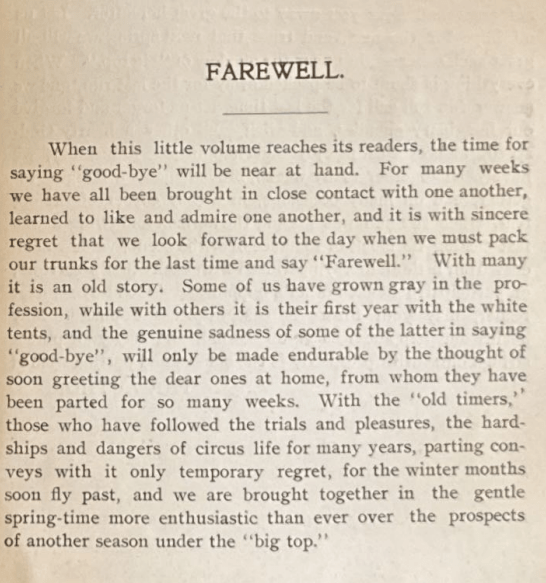
As we depart, take a look at this farewell page from the Pawnee Bill Wild West Show Official Route Book of 1898. As you read it, think of Ed Fay as a person who worked for shows with idealized camaraderie. One is struck with the writer’s sentiment of wanting to participate, belong, stay, and/or return again; but the reality that the show is, after all, just a show with no enduring commitment or promise of career.
Above two images from the Season 1898 Official Route Book of the Pawnee Bill Wild West Show compiled by H. G. Wilson, courtesy of the Western Historical Collections****
William Williams
Citations
*Gordon William Lillie Collection, Box #3, Folder # 2, Western History Collections, Special Research Collections, University of Oklahoma Libraries, Norman, Oklahoma
**Gordon William Lillie Collection, Box #3, Folder #2, Western History Collections, Special Research Collections, University of Oklahoma Libraries, Norman, Oklahoma
***Gordon William Lillie Collection, Box #1, Western History Collections, Special Research Collections, University of Oklahoma Libraries, Norman, Oklahoma
****Gordon William Lillie Collection, Season 1898 Official Route Book of the Pawnee Bill Wild West Show, Compiled by H. G. Wilson, Published by O. J. Krause, 1898, pp. 113-114, Box #13, File #1, Western History Collections, Special Research Collections, University of Oklahoma Libraries, Norman, Oklahoma
I look through a foggy window, peering to see the man on the other side. His last name was Fay. His wife knew him as Edgar Fay. None of the people who knew Edgar directly are alive today. Walter Dempsey Fay was the third child of Edgar and his wife Mellie. When Walter grew to adulthood and related family stories to his children, he described his father as a kind, loving man who was very fond of family. He also remembered him as a man who worked hard, even leaving home to find work during the depression, never to return home, presumed dead, though no body was ever found. Walter, his sister Rose, his brother James, and their mother were devastated. Walter and his siblings, all children when he disappeared, were convinced that surely their father was still alive. They all continued to look for clues about him, his heritage, and his fate, throughout their lives.
The clues for Edgar were few. They came from a few things told by Walter, prior to Walter’s death, and from the adult children of James. Here were the clues: Edgar Fay was born in Council Bluffs, Iowa, a fact he told his children over the years and that the children remembered. Prior to his marriage in Arkansas at 43 years of age to Mellie Burns, he did circus and rodeo work. The children, and later the grandchildren, avoided asking Mellie about Edgar over the years, not wanting to upset her. She died in 1973, taking her knowledge of Edgar, his past, the beginnings of their relationship, and his family with her. Among Mellie’s belongings left behind, there were no photographs, letters, diary, or writings by or about Edgar to give us guidance.
The path to find Edgar Fay has been long and adventurous. It involved interviewing family members for their memories as clues, DNA testing, and intensive traditional research and genealogy techniques. Eventually, I will write about the discovery process. But first, it is time to write about Edgar and his life. The desire to write has been strong, but until recently, the foggy window made it hard to see Edgar’s face, to understand him as a person. Recently, the window came ajar. As we gradually open the window further, we see Edgar as he begins to come into view. We still cannot see him fully, yet he is ready for us begin telling his story.
Over the next weeks, you will hear about Edgar’s heritage and youth, his young adulthood, and his married life and what may have been his demise. Thank you for coming along for the journey!
A sixteen-year-old boy in Franklin, Nebraska left home in 1893. He left with “an older companion,” leaving his parents and siblings upset and concerned. He was not heard from for years. His family moved to Montrose, Colorado by the turn of the century. The boy, as a grown man now known as Edgar Fay, was in Arkansas by 1917, where he married a much younger Miss Mellie Burns from Arkadelphia, and he registered for the World War I draft. Where was Edgar between 1893 and 1917? Edgar’s son Walter Dempsey Fay, who only had childhood memories of his father, later would tell his children the couple of facts that he knew knew about Edgar. One was that Edgar was born, “in Council Bluffs, Iowa.” The other was that Edgar had traveled with a circus or rodeo at some point before he married.
Soon I will write more about Edgar (aka Wooster A. Fay) and the search for him to locate his original family. Today I delve into the time between 1893 and 1917 and the world into which Edgar “Ed” might have stepped.
Why would a boy leave home in Nebraska in 1893? A Google search identified a very clear possibility: In 1893, Buffalo Bill regenerated his Wild West Show in order to perform during the Chicago World’s Fair! …and Buffalo Bill and his family had a home where they resided in Nebraska, just upstream on the Platte River, which passed not far north of Franklin.
I am not from Nebraska, so the presence of Buffalo Bill in Nebraska lexicon was news to me, and quite exciting. Edgar was a student at the Franklin Academy, which was a prestigious high school, the only one in Nebraska at the time, and the only one between Missouri and Denver. It was a boarding school, so students from many locations resided at the school. Ed was a day student, living nearby with his family, but would have known all the other students. Any of the older students or their family members may have had connections with Wild West recruiting. Ed, the oldest son of the family, lived on a farm at the edge of town, and we know that his father, whose career was listed as “farmer,” depended upon Ed’s hard work. Due to his work, age, and location, Ed would have been an accomplished rider and horseman. We also are told by descendants of his youngest brother Justin Brooks Fay that the boys were worked quite hard; there were lots of children, too many to fit into the house, and the boys lived in the barn. What if this teenage boy had an opportunity to join a Wild West show and to be paid for the work? How could that not be alluring?!
As additional information that could contribute to the allure, Ed Fay would have heard about , and might have attended, Buffalo Bill’s Wild West Show’s inaugural performance in Omaha, Nebraska, May 19, 1883. That year, Ed, his family, and his grandparents were living across the river from Omaha in Council Bluffs, Iowa, and little Ed would have been about six years of age.
I confess that the first time I heard about the term “circus,” as the past work for Ed Fay, I thought of circuses that were prominent, touring the United States during the 1960’s – 1980’s. I initially did not know the identity of Ed’s family or where he grew up, other than the Iowa reference. I also never contemplated what a “circus” of his era might have been, even when I discovered his Nebraska/Colorado connection. As I researched Buffalo Bill’s Wild West shows, it became clear to me that several terms were used somewhat interchangeably, including “extravaganza,” “circus,” “amusement,” carnival,” and “Rough Riders.”
Mabel Hackney and Skyrocket Jumping a Table, from Mabel Tompkins Collection, courtesy of Oklahoma History Center, Oklahoma City, Oklahoma
The name and photograph of Mabel Hackney appeared last week as a historical photo as I perused social media (Did you know there are great historical and genealogical finds on social media?!) In the photo, Mable was mesmerizing, side-saddled on a lovely horse jumping deftly, as Mabel showed grace and confidence. It happens that Mabel was a cowgirl who performed with Buffalo Bill’s Wild West Show, then married cowboy and showman Charles Tompkins and retired in El Reno, Oklahoma. El Reno is about 30 miles west of Oklahoma City, a significant key to Ed Fay’s story. Ed’s future wire Mellie’s grandmother Lucy Jayne Harles Craig was a widow living in Oklahoma City by 1900, and Mellie was born in Indian Territory in 1890. Because of the potential for Oklahoma City to be the bridge between Ed Fay’s Nebraska and Mellie’s Arkansas location, it made sense to research Mabel and Charles.
There are several photos of Mable Hackney Tompkins online. The photos are from the Mabel Tompkins Collection at the Oklahoma History Center in Oklahoma City, Oklahoma. I arranged to view the collection, giving me a view into the world of the Wild West shows of the late 19th and early 20th centuries.
Mabel was a young woman who grew up in Kansas and became proficient in riding and horsemanship. She came to the attention of Buffalo Bill William Cody who offered her an opportunity to join his show in 1898, her first job! She continued to perform with the Wild West Show until she became injured and took time off to recover.
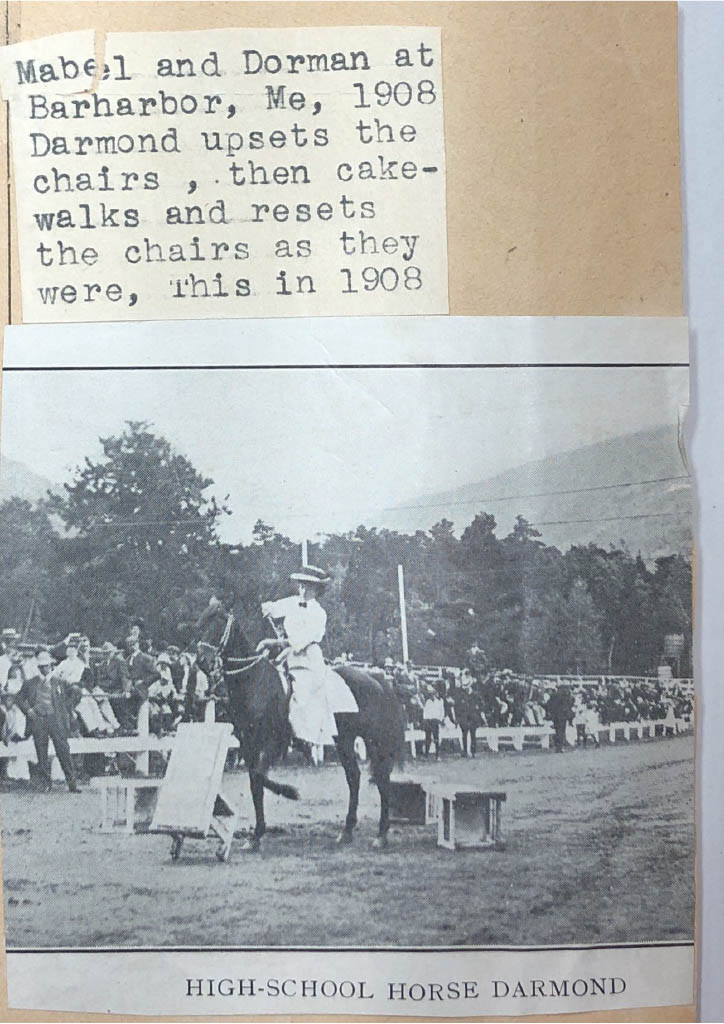
Mabel’s riding included expert jumping, later developing an act in which she would jump a horse over a table at which a group of gentlemen were leisurely enjoying their beverages. Her horses also were trained to race chariots, cakewalk, dance, and engage in tight maneuvers and tricks, like knocking down chairs and setting them back into place. Mabel won many awards for her horsemanship.
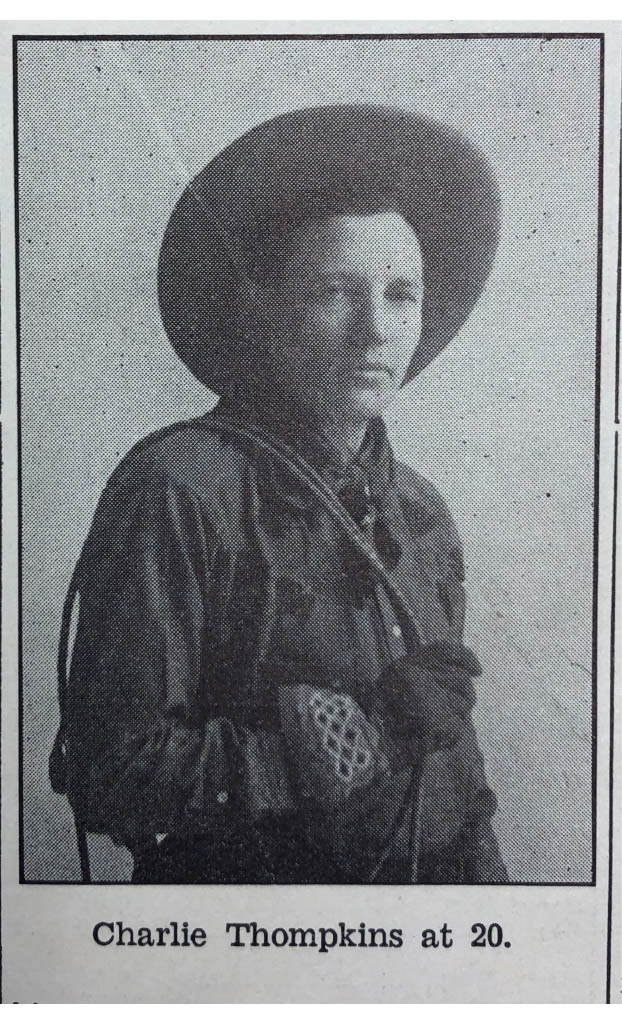
Charles Tompkins from the Mabel Tompkins Collection, courtesy of Oklahoma History Center, Oklahoma City, Oklahoma
Meanwhile, Charles Tompkins was a young man from Texas who began working with cattle as a pre-adolescent and joined a couple of the major cattle drives to Montana. Charles learned to break and train horses, and he became a skilled bucking bronco rider and roper.
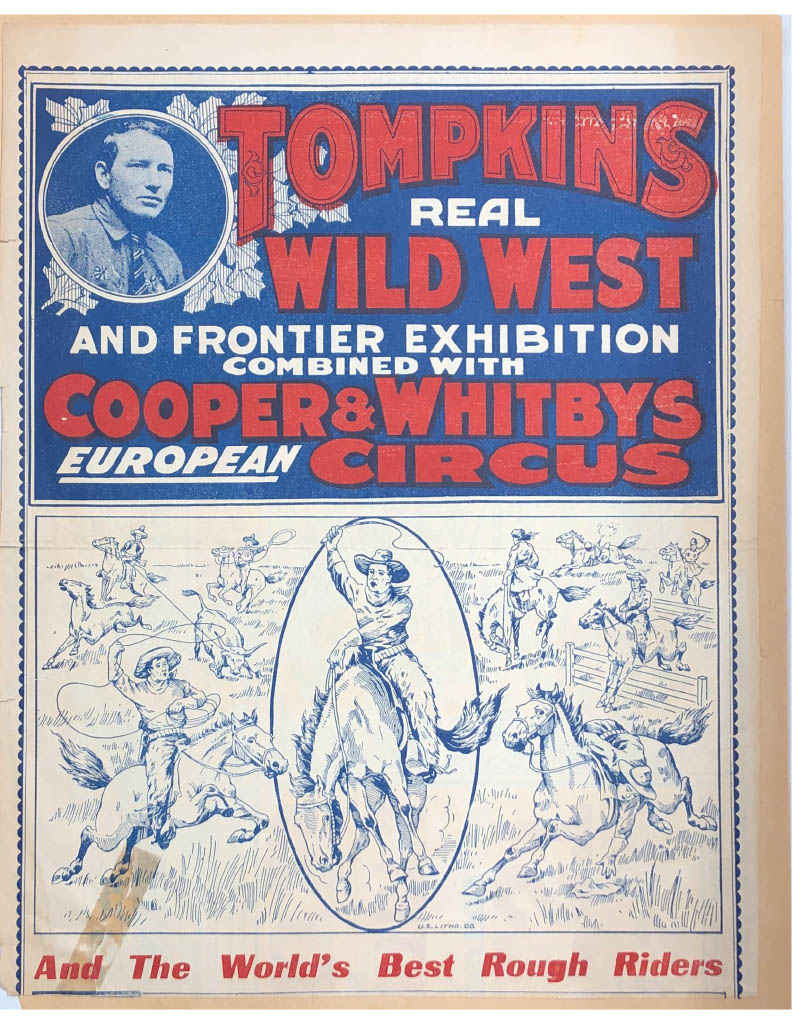
Through Buffalo Bill, Charles met Mabel while she was rehabilitating from her injury, and they married about a year later in 1904. As a couple, they started their own Wild West shows. They formed different iterations of their shows across the years. In most cases, Mabel and Charles were the premier solo acts. They also hired other acts to round out the offerings, going from one town to another during their touring season. On a couple of occasions, they joined other shows, and they toured in Europe extensively. In 1918 the couple moved to El Reno and retired from their traveling shows.
Mabel Hackney and Darmon, from the Mabel Tompkins Collection, courtesy of Oklahoma History Center, Oklahoma City, Oklahoma
Newspaper clippings show consistent work across the years. The shows traversed the United States, including the 1904 St. Louis World’s Fair, Philadelphia, New Jersey, New York, Cincinnati, and Florida. Most cities were met with return engagements in subsequent years.
Mabel and “Dorman” in Maine, 1908, from Mabel Tompkins Collection, courtesy of Oklahoma History Center, Oklahoma City, Oklahoma
Some of the touring acts they assembled, especially the early shows, focused upon western bronco riding, lasso and lariat tricks, knife throwing, and sharp shooting. The Wild West show included native Americans with reenactments of Indian/white conflicts. There were some shows that included riders from Europe and Russia performing riding and tricks from their traditions. On at least one occasion, Charles and Mabel were involved in projects Charles directed that combined four different shows, with hundreds of horses and many riders and entertainers.
While the riding and western skills were a large component of these shows, the term “circus” often was used, and that what later came to be considered more common circus acts were included more and more as well. Exotic animals, exotic people, trapeze, and knife throwing were included in some of these shows.
from the Helen Tompkins Collection, courtesy of Oklahoma History Center, Oklahoma City, Oklahoma
On at least one occasion, they traveled to Europe for extended tours. There is an interesting account of Charles’ getting his Indian participants to the location they were supposed to perform.
There were mishaps. Injuries and falls were common. The shows met with some crooks and foul weather. There was an instance of a show having to close in Europe when the impresario went bankrupt, leaving performers stranded.
Charles must have been a master entrepreneur, skilled in management and organization, as well as marketing and promotion. He and Mabel had clear rules for their employees. Their contracts were quite specific. They communicated well with those venues where they performed. Their were heavily involved in the advance work, and they managed the travel from location to location and getting their people from one event tot he next. To be fair, from the materials left by Charles and Mabel, it is not entirely clear which of the two was responsible for which managerial work. There is one document from their first show that is attributed to Mabel, with her list of the acts employed for that season. She is described as being very sensitive to the employees and concerned for them as individuals and for their well-being. There clearly is writing we can attribute to Charles, including letters and historical summaries that he signed. By the way, his excellent written, and presumably spoken, communication skills are a boon to us today, since we have such lovely summaries and documentation of the Tompkins’ lives.
Mabel and Charles maintained good connections with the people they met… and oh, the people they met! Will Rogers worked for their show in their early years. Mabel performed in the Buffalo Bill show with cowgirls Annie Oakley and Lucille Mulhall. With many of the people they met and with whom they worked, even from the days Mabel worked with Buffalo Bill, the Tompkins maintained firm and fast connections and friendships.
Christmas Card and Note from horsewoman Lucille Mulhall, from Mabel Tompkins Collection, courtesy of Oklahoma History Center, Oklahoma City, Oklahoma
We must highlight Gordon William Lillie (1860-1942), otherwise known as Pawnee Bill, and his wife May Manning Lillie who as an equestrian and sharpshooter. Pawnee Bill worked as Pawnee Indian interpreter for the Buffalo Bill show. May Manning Lillie was a Philadelphia Quaker student at Smith College. Lillie met May by happenstance when she was 15 and the show was touring in Philadelphia. The couple married a couple of years later, following an intense effort by Bill to earn her parents’ approval, and upon May’s graduation from school. May embraced the western way of life, and her business acumen added greatly to their partnership. In 1888 the Lillies started their wild west show, with May the star. Their shows evolved to include acts from other continents. After some mis-steps, their shows had very successful European tours, and they became a major competitor for Buffalo Bill’s Wild West shows.
Buffalo Bill and Pawnee Bill joined forces in 1908 and established “Buffalo Bill’s Wild West and Pawnee Bill’s Great Far East,” also known as “The Two Bill’s.” The show was quite an extravaganza, but heartily opposed by May, who was concerned that William Cody’s poor financial management and his wild ways would be the downfall of the venture. Evidently she was correct. The show went bankrupt and ended in Denver, Colorado in 1913. The couple went on to do shows and showcases on their 5000 acre ranch in Pawnee, Oklahoma, and they were very involved in promotion of Oklahoma, conservation of buffalo, and other civic endeavors.
The Tompkins’ retirement to El Reno provided opportunities for continued connection and friendship with the Lillies. Charles became a businessman, owning an automobile dealership, and he and Mabel continued involvement in the Oklahoma State Fair and establishment and support of rodeos. Charles and G. W. Lillie both were involved in improvements of Route 66/64. Charles became a regional W. P. A. supervisor during the Great Depression. The Tompkins and Lillies had much in common. It is easy to imagine a visit between Mabel and May; how much in common they shared in skills, experiences, and as trail blazers; and how much potential mutual support and camaraderie they might have enjoyed.
Newspaper clipping of European tour of Wild West show, featuring Mabel Hackney “Queen of the Prairie” and Charles Tompkins “King of the Texas Cowboys,” from Mabel Tompkins Collection, courtesy of Oklahoma History Center, Oklahoma City, Oklahoma
In reading the articles about the Tompkins’ shows as they toured to towns across the United States, the excitement of the events is palpable. While some of the news articles included staple advance material regarding the acts, most were written by local reporters who gushed about the impending excitement in the town as they anticipated the event. Also evident were the reporters’ and audience reaction to the expertise, and I daresay the showmanship, of the riders and performers. It is hard to find a modern equivalent to the western riders engaged in masterful feats, showcasing prize horses and expert horsemanship with cowboys, cowgirls, and Indians in all their allure and magnificence.
It is hard to read now, today, some of the accounts, laying bare the minimization of the Indian plight and misrepresentation of events like Wounded Knee. Our mission here, though, today is to look at what might have led a boy to leave home and school What might have captured his heart and attention. In addition to Buffalo Bill’s Wild West Show, there were many other touring shows, including those of the Tompkins and Pawnee Bill. Across the period of several decades, the various acts and performers seemed to join with the various shows, depending upon schedule, opportunity, and probably the pay. Promoters, especially into the early 1900’s, also developed movies and plays that employed ensembles of skilled and trick riders and ropers.
Will we ever locate Ed Fay during this era? So far, we have not. Buffalo Bill’s employee records are sparse. Among the papers of Mabel Hackney and Charles Tompkins, there are no formal employee records. I saw the one early list of names of some of the riders the Tompkins employed in one early show. Newspaper articles occasionally list principal riders, then indicate “cowboys,” without naming them. In addition, one would think that there were other unnamed employees who helped train and break horses, transport and care for the animals, do advance work, set up and take down living quarters, drive wagons, or engage in any number of functions. These workers would not normally be listed in any newspaper article. It is daunting to think of tracking down every show to see if there are any surviving records, much less any lists of employees.
Thanks so much to the lovely Mabel Hackney for bringing the world of cowgirls and cowboys to light, showing me that a kid growing up in the late 1800’s in the Midwest might see heroes in a world that showcased skills that could be learned in the course of rural life. Without a doubt, the timing, location, and allure of the Wild West Show for a teenage boy in Nebraska in 1893 make Buffalo Bill and appealing hero in the year of the 1893 Chicago World’s Fair– a dream to pursue!
Acknowledgements: Thank you to the Oklahoma History Center, their archivist, and their staff. The article would not be possible without access to the 1988.007 Mabel Tompkins Collection. All photos are from the Mabel Tompkins Collection. http://www.okhistory.org
Thank you, also, to Angie Blank and the Franklin County (Nebraska) Museum which provided great resources and support in locating documents about and from the Franklin Academy, and for facilitating contact with the First Congregational Church of Franklin and location of land and other supporting documents. Their insights into western shows and local legends also helped contextualize our research. https://www.facebook.com/pages/Franklin-County-Museum/279155045580328













 Ancestors Worthy the Note