
Recent world events have me thinking again about how distant people have become from each other…distant from their prior accustomed social circles… churches, families, neighborhoods, schools, friendships. Check my earlier posts in this estrangement series, if you have not already, for discussions about alienation and estrangements and the many causes, impacts, and permutations.
We have spent time discussing the pain of estrangements and how difficult they can be, regardless of where one is in the estranged space. There often is a tendency to want things fixed sooner rather than later, and expectations often are all-or-nothing…and sometimes, to have it “fixed” yesterday. What if there is another way forward that we have not considered before? Rather than all-or-nothing approaches and expectations, regardless of where you are within an estranged situation, consider whether MOSAICS can show another way to move to a better space.
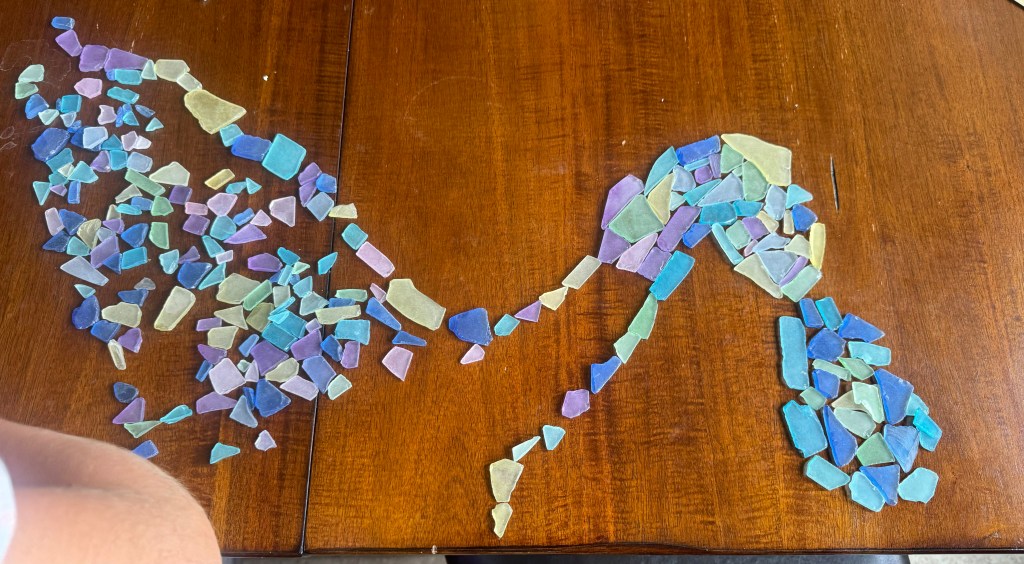
I am a fan of mosaics. Visualize a large piece of art or image which, upon closer inspection, is made of smaller pieces, maybe dime-sized or smaller. Mosaics may be made of glass, jewels, metals, stones, paper, cloth, guitar picks, or pretty much any other object you can fathom. You also may have seen large images that are made of tiny mosaic pieces that are tiny photographs of non- or semi-related subjects.

Often children or art students experience mosaic projects in their art classes, or as kits gifted or purchased. The finished items can become wall art or stepping stones.
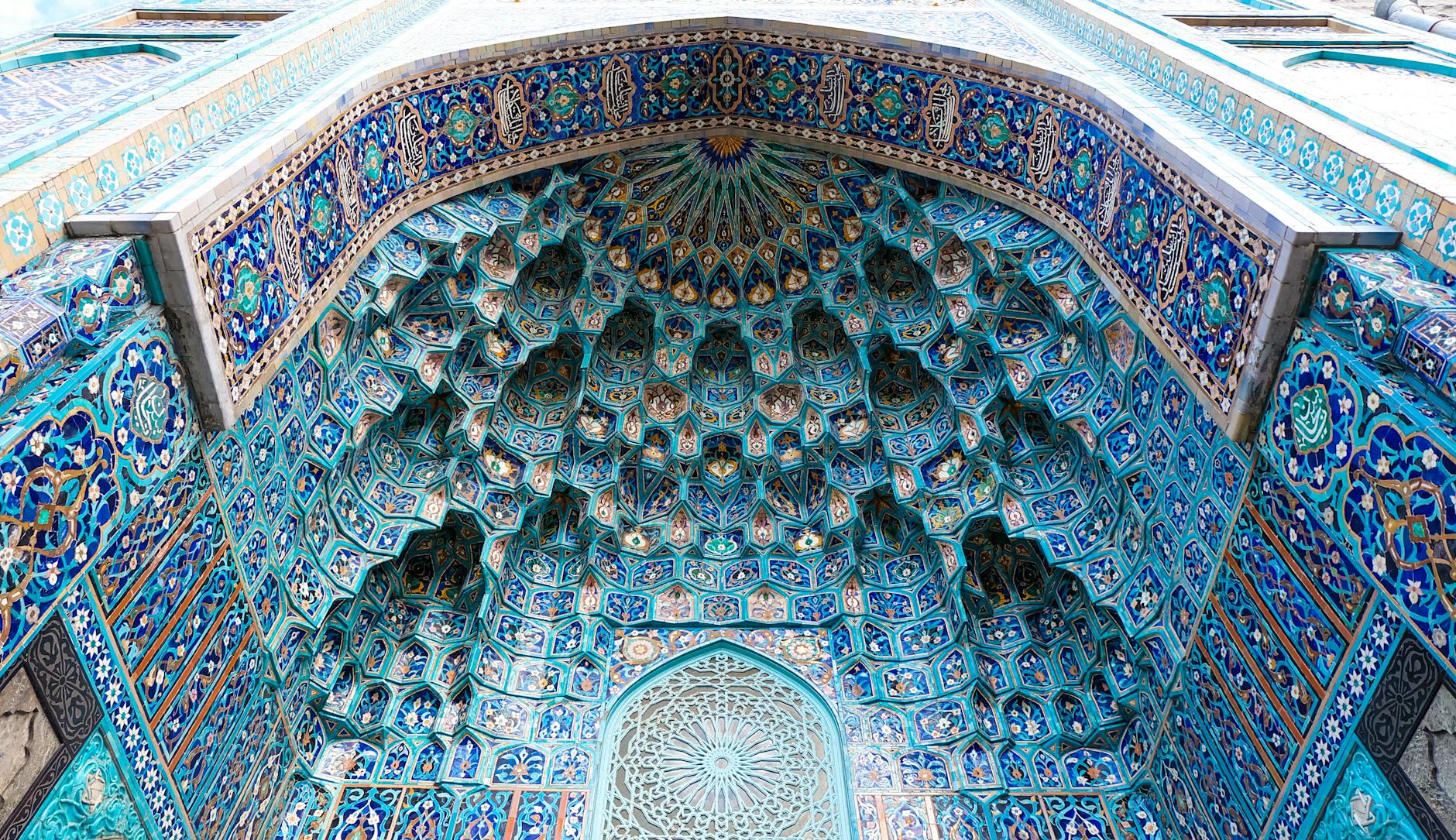
In travels, wonderful mosaic creations are destinations of awe. One remarkable location is The Cathedral Basilica of St. Louis. It is the *new* basilica in St. Louis, Missouri, not the original edifice on the Mississippi River. Many of the spaces within the cathedral feature glass mosaic installations by over twelve artists, including Tiffany Studios, each artist designing a specific room or area. With the right light, the mosaic images are spectacular and inspiring, whether viewed at close range, or at the highest expanse of the interior dome.

One of my favorite experiences with mosaic has been to rescue a beloved object that has broken and to refashion it as an art piece. Sometimes there is nothing to do but throw away broken glass. The object may be so fractured into such small pieces or dangerous shards that the pieces cannot be safely repurposed. If one is fortunate, the broken pieces can be gathered safely, placed artistically, and mounted onto a base that can be framed, using forms of adhesive and grout to secure the items so that we can visually enjoy them again.

Similarly, found-glass fragments can be collected, whether from clearing an old building site, an attic, a cellar, or estate sales. One can find vintage pieces, from broken medicine bottles, jars, stoneware, glassware, or china. Each piece has a story. If the items are from your past or the past of people you know, you sense the story that they hold. More often, the fragments’ origin stories are lost to time. Still, these antique items can be used as mosaic pieces to fashion a larger piece, either strictly for decorative use, or for practical use, including coasters, hotplates, or garden installations. The idea of lost, broken pieces from the past, composing an integrated piece of art that speaks to us, truly, is a special, inspiring act of creativity.

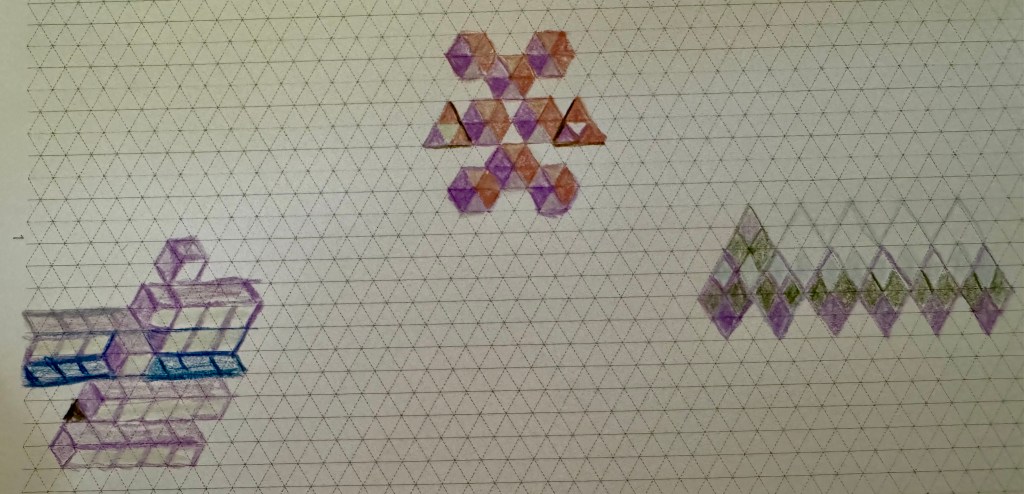
I recently, evidently late-to-the-party, came across a technique for making mosaic designs from isometric graph paper, which features equilateral triangles. The technique is in common use among some quilters and other fiber artists who design three-dimensional effects. Colored pencils are applied to individual triangles on two-dimensional paper, the colors used to indicate shading and highlight of shapes. It is you, the artist, who makes the choices required to bring the flat images into 3-D relief. The choices are boundless/unlimited. Practically, the grids are translated to mechanisms to bring a fabric or item to life. For us, the practice shows how our mind can move pieces around just with our perspective and ideas. Each *piece* or triangle is important, and can be a part of something bigger, depending upon our perspective and inspiration.
So, these ideas inspire me as I think about estrangement and reconciliation.
Part of the inspiration comes from awareness of the wonder in acquiring one mosaic piece, not only as an object individually, but for its potential. After all… I suppose, technically, a piece is just a piece. It is only a MOSAIC piece through its potential to be acquired and given a place in a larger arrangement in which it is but one component.
What if, wherever one is within an estrangement–whether the one who estranged, the one from whom the other estranged, family/friends of the estranged parties, or one who is in the middle–one finds it possible to engage with the other briefly in a safe way…a friendly exchange, a congratulations, a birthday greeting. Maybe that’s it. No more. It is one element, one mosaic piece. Or, what if another, neutral but loving and concerned friend or family member within the situation provides support to you in some way, validating your sadness or anxiety, giving you reassurance and expressing concern? Well, that’s another mosaic piece. Maybe that’s it. No more. Perhaps you start to notice that you feel a little, tiny bit better about things, maybe some relief? Maybe some safety? Hmm. That’s another mosaic piece. Maybe that’s it. No more. Or, maybe it’s easier to pray about the situation with a little bit more positivity and genuine love. Yes, you guessed it…another mosaic piece. Any of these or other situations can occur individually or sequentially, and any positive or lateral movement is something to be noticed and accepted.
So, mosaic pieces, in this case, come as a surprise, a gift. They are NON-LINEAR–one does not necessarily lead to another, and if another piece arises, it may have nothing to do with the first one. When you receive the gift of a mosaic piece, you accept it, as best you can, and try to not flip into an all-or-nothing stance… of needing to single-handedly wish/compel a full reconciliation. In a way, accepting mosaic pieces is a way to describe the fact that we are in a situation over which we have very little control.
“So, mosaic pieces, in this case, come as a surprise, a gift.”

The key is the openness to the experience and seeing the non-linearity. You do NOT have to totally open the door just because you accepted a mosaic piece that you find hopeful or helpful.
“You do NOT have to totally open the door just because you accepted a mosaic piece that you find hopeful or helpful.”
Once you discover more mosaic pieces, you may find that they come to you from different estrangement experiences that are not connected in any way. Maybe you attend a reunion and discover information that is healing. Maybe from a memorial service you connect with a mutual acquaintance of the deceased. You have a conversation with a friend or trusted person that gives insight into a situation that broadens your perspective and softens your heart. Any of these experiences were not sought by you, and they perhaps were directly related to your estrangement experience. They likely come as total surprises to you. Yet, the insights from these singular events can apply to the big picture, including the estrangement. And each experience is another gift of a mosaic piece in your growing acquisition.
Another analogy is that as you collect one mosaic piece, you place them as you consider layout. In doing so, a larger picture emerges, based upon hints or features of the pieces you amass. Mosaic pieces’ size, shading, and detailing hint toward a larger view and inspire a comprehensive arrangement. The same approach applies to emotional and intellectual mosaic pieces. As you consider them individually and in totality, you will integrate the concepts and experiences. Consideration can occur through contemplation, journaling, conversation, art, or music. All of these processes can take time, and likely they will shift with time, which is a normal growth and healing process.
“The key is the openness to the experience and seeing the non-linearity.”
Now I want to add a twist to the mosaic analogy. Depending upon your situation, the mosaic perspective is a tool to CREATE a solution to a particular dilemma. If, for example, you are in crisis, yet you are estranged from those who do care about you, is there a way you can find someone, an intermediary, to create a safe way to communicate your status and receive a modicum of support? Maybe a P.O. Box for notes exchanged? Maybe a blog for posting updates? Intermediaries sometimes create private Facebook Groups for rallying around a person in crisis, including illness or grief, and these are monitored/facilitated pages that can be a safe place to communicate. It can be relieving and healing to know that you can create mosaics as bridges toward connection while maintaining boundaries and safety.* A psychologist or trusted pastor may be helpful in creating such a mosaic or mosaic piece that would be safe for you.**

Mosaic pieces, whether objects or experiences, are bits that we can accept when they come our way. As we collect them, we begin arranging them in ways that, if nothing else, help us to cultivate a sense of peace, healing, and compassion, allowing us to move forward in our progress toward wholeness. As lovely as large mosaic works may be, even small, meaningful ones may be all that we need for our peace.
May you find yourself open to seeing mosaic pieces as they arise in your life and to receiving comfort from them.

*As always, individuals need to take into consideration their actual safety and should maintain necessary physical and emotional protection. Even in situations requiring significant boundary maintenance, mosaic concepts can be used for internal healing and reconciliation work.
**A recent article in the New York Times underscores what apparently is a troubling trend with “therapists” using TikTok for advocating estrangements from family, “Is Cutting Off Your Family Good Therapy?” Ellen Barry, New York Times, Published July 14, 2024, Updated July 17, 2024. While the trend ostensibly is strictly for people in abusive situations, the worry about the trend is several-fold: 1) The article stresses, correctly, the idea that therapists should not be telling clients what to do… boundaries are for patients to set. 2) TikTok videos about any mental health situation lack individual consultation and considerations, setting people up to assume a diagnosis or to take *advice* that should not apply to them. 3) The trend smacks of one-size-fits-all treatments which can contribute to much harm regarding individuals’ understanding of their situation and lacking the nuance and individuality each person deserves. 4) The article suggests the trend promotes a sweeping praise for and assumption of estrangement as beneficial. In fact, most people, in most situations, can establish healthy boundaries; improve communication; and empower individuation without the need for estrangement, even if they have episodes that are bumps in the road in their relationships with their friends and family. A good takeaway from the article is that each of us should guard against any feel-good trend, whether from a book/article/video/social media post/expert who advocates estrangement as a quick-fix for your mental health. Get second/third opinions, and understand all of your options and that situations/people are dynamic throughout one’s lifespan. Estrangements are not without serious negative risks for all involved. https://www.nytimes.com/2024/07/14/health/therapy-family-estrangement.html?unlocked_article_code=1.-k0.poJa.QXgEL44FIWUq&smid=url-share
***Special thanks to the student artists who contributed to this blog with their inspiration and artistry.
 Ancestors Worthy the Note